Showing posts with label Pompous proclamations. Show all posts

Friday, May 29, 2026

If you can’t bring footie to the kiwis…

Despite living in Australia for nearly 30 years, I have only recently become aware of the Barassi Line. While I have known for years that the rugbies are east coast sports, and Aussie rules is a game of the South and West, I had no idea that there was a formal demarcation until just last week. So this blog is the natural place for me to think through the implications of this line.

First of all, the test of any scientific theory is whether it has explanatory value beyond the data used to define it. The figure below shows the Barassi line extended into the Southern Ocean. As it shows, the line clearly delineates the rugby-mad islands of NZ (both the main islands and the scattered volcanoes of the Campbell Plateau), from Tasmania-and therefore Aussie Rules- affiliated Macquarie Island. Rugby is king in modern day New Zealand, and this is exactly what the line predicts based on the present position of the islands.


Of course, it is unlikely that the whales of the southern ocean will play either code of football. They can neither catch nor kick. So in order to guide Australia’s soft power and cultural projection, it is useful to look at the extension of the Barassi Line on the other direction- towards Asia.


Once again, the Barassi Line has predictive value; It correctly assigns Japan, Oceana and the island of New Guinea to rugbylandia. Furthermore, the cricket-playing heartland of the Indian Ocean Basin is footie aligned. This is important, since Aussie Rules is played on a cricket oval. Should the Australian porting codes attempt to carve up China, the line suggests that rugby should go for East and North China, while the South is fertile ground for Aussie Rules.

Of course, while it is easy to fantasize about where the Australian football codes might spread to, cold hard science can predict what lands will travel to the football codes.  This is, of course, a geology blog. And the main explanatory theory of Earth Science for the last 60 years has been plate tectonics. And plate tectonics is such a powerful and wide-ranging theory that it explains not only earthquakes and volcanoes, and continental drift, but also code switching.

As previously mentioned, New Zealand today is a rugby haven. And I have no doubt that the Aukland area will always be. But New Zealand is not a craton; the country straddles a plate boundary.

Every year, the eastern side of the South Island, part of the Pacific Plate, slides approximately 38mm relative to the Australian plate. The direction of movement is to the southwest- towards the Barassi line.


Thus, we can predict that in approximately 16 million years, New Zealand’s southernmost village of Oban will cross the Barassi line as Eastern NZ slides southwards along the Alpine fault. This will not be a sudden change; it will take approximately four thousand years for a standard 165 meter pitch to completely cross from one side to the other. So by the time the north goalposts appear, the south goalposts will be as old as the Egyptian Pyramids are today. Never-the-less, I expect the rituals of football to endure as civilizations rise and fall around the pitch.

Invercargill, the southernmost substantial mainland city, will cross over 1.2 million years later. 4.3 million years after that, Dunedin will cross the line, and the Highlanders will be forced to leave Super Rugby for the AFL. The mighty Crusaders would have another 10.4 million years of super rugby dominance before they, too, cross over to Aussie Rules.

Now, to an aficionado of either major football code, this sort of change may seem outlandish, even on the geological timescales. But a lot can happen in 20 million years. For example, 20 million years ago, the Otago region of New Zealand now inhabited by rugby players hosted forests full of eucalyptus, casuarina, and hoop pines, while the wetlands were inhabited by crocodiles. The forest types were similar to those found in the Gold Coast Hinterland, very different to the dry tussock grasslands of today. So it is not so outlandish to predict that in a similar amount of time in the future, at least the football codes night re-Australianise.

It is not a question of if Aussie Rules will take over the southlands, it is written in stone. Continental drift may be slow, but it is implacable and inexorable. The only question is whether or not the 30 million seasons between now and Canterbury joining the AFL and increasing competition is enough time for St Kilda to win at least one more premiership.

Tuesday, March 24, 2015

Taking a PhD into the real world

Here in Canberra, the “Science meets Parliament” event is running.  I am not attending- the luminaries and power players can do their thing, but out on the wrong side of the tracks, our factory needs to keep putting lasers on sharks for the good of the economy.  Luckily, some of the scientists there have taken to twitter, so snippets and thoughts are able to escape.  Given that engagement is one of the things on their agenda, I thought I would chime in.

One of the topics mentioned was non-academic careers for recently graduated science PhD holders.  As someone who has worked in academia, industry, and government since graduating a long long time ago, I figured I’d take the opportunity to chime in with my two cents.  Note, however, that this is only 0.000022% of the attendance fee for the event, so discount this advice accordingly.

As a result of the deprofessionalization of science, there are no longer copious private sector basic research jobs for scientists to graduate into.  They do still exist, but not nearly in the numbers required to take all the PhD students who are excess to the requirements of the academic machine. 

The other problem with this retreat by science into the ivory towers of academia is that people in the real world- including employers- are less likely to really understand what scientists do, and what specifically a PhD graduate has to offer.

When a person leaves university with their PhD in hand, they generally have three things:  A tacky outfit (gown, hat, etc), a body of in-depth knowledge that makes them the world expert in a very small field of study, and the ability to do research.  Only the third of these is a salable skill, except in extraordinary conditions. This puts students leaving academia in a very different boat than those continuing on to a post-doc, where expanding or leveraging your field of PhD study (the second thing) is standard practice.

As a result, PhD-holding job seekers can be a bit disoriented.  This leads to all sorts of sad situations, including those where graduates leave their degrees off of their CV’s in hopes that this makes them more employable.  However, this is a suboptimal solution.

Furthermore, being able to figure things out which aren’t known is a really useful skill in a variety of situations.  Even with Wikipedia in our phones, understanding basic derivations lets us estimate things faster than fingers can tap screens. It lets us solve problems that may not have ready solutions published in a publically available place; it lets us adapt to changing circumstances where the underlying issues are constant, but the specific combinations of problems is changing in a way that makes simply looking up a solution impossible.  Being able to figure out how the world works is a useful, marketable skill, but to be valuable to us we need to make sure that we don’t devalue it.

There are a few things that scientists entering the normal workforce need to remember.  Firstly, in private enterprise, time is money.  There is a bad habit in poorly supervised PhD programs to devalue a student’s time- basically tell them to take however long it takes them to do some particular task.  In private enterprise, where the accountants will be tracking your billable hours and balancing project budgets, it is very important to use time effectively.  Ask for help, communicate with your colleagues, copy what your predecessor did; all of these things are preferable to spending a week proving that you can independently derive shit. 

The corollary to this point is that you need to value your time, and make your employer and clients value it as well.  Earning a PhD takes years of study and effort- an outlay similar to becoming a doctor or a lawyer as a postgraduate course of study. Business people generally assume that things are- to some extent- worth what they cost; a person who charges himself out at marginally more than grad school rates will give the impression that he has little to offer.

Of course, the academic meatgrinder doesn’t want any of this to happen.  As long as academia thinks of PhD programs as molds for the next generation of instructors to be injected into, it will try to make them as cheap as possible.  This is why PhD graduate supply is high, demand is low, and employment tactics like adjuncting place downward pressure on wages and conditions.  Universities don’t want PhD’s to succeed; that will cost them money down the road.


Luckily, those of us in the Earth Sciences are in a position where, at least in Australia, there are plenty of other opportunities around.  Impoverishing your students only makes sense if you plan on eventually hiring them; if most of them are destined for careers outside of academia, then an academic institution gets the most benefit by having graduates get rich enough that they want to give money back to their schools. If enough scientists become professionals of some description or another, then the schools will eventually think of use as being more like lawyers than English majors, catch on, and put some effort into professional development of research students.  Until then, though, it is up to us to help each other.

Tuesday, September 13, 2011

An example of peer review

Dear Editor Smith,
I return the Doe et al. manuscript number 5623646 with numerous comments. In my opinion, the manuscript will not be fit for publication until all the flaws described below are corrected:

Title

The title of this paper does not reflect the sort of study which I would like to see done on this material. Please instruct the authors to change it, instead of using the title to push their own agendii.

Introduction

While the paper is nominally about solid solution in simple oxides, the narrow focus of the introduction has resulted in a failure to cite the well-known avian migration papers of Lemming et al. (2003), and Lemming and Aardvark (1998), both of which ought to be mentioned for completeness. Without tying mineral solid solution to bird migration (ibid), econometrics (Lemming and Wesson 2002), and mass spectrometry Lemming et al. 2009), the author fails to cite as wide a selection of my papers as he otherwise could. This indicates an inability to place the science in the broader context of society. Without this context, their results are neither novel nor interesting.

Methods

Like the title, the methods of this paper fail to pursue the angle of inquiry which I would have used, had I their skillsets and funding. This is obviously a serious error. Please require the authors to have done something other than the experiments whose results they are reporting. They would do well to cite Lemming et al. (2009) for the analytical procedures I prefer.

Results

In the first experiment, where the precision is twice as bad as Lemming and Stoat (2006), the data is obviously not precise enough to be worthy of presentation. The second experiment, with precision twice as good as Lemming and Stoat (2006), is obviously too good to be true, and must be the result of incorrect error propagation or outright forgery.

Discussion

Once again, the lack of citations to my unrelated papers is a serious flaw. In addition, the authors insist on drawing conclusions based on their data, and not my preconceptions of where the field was 15 years ago. Ignoring the work that they misguidedly performed renders the rest of their study irrelevant. In fact, their constraints and discussion of the experiments they DIDN’T do is practically nonexistent. This is clearly unscientific. There is a problem of nomenclature as well. The proposed mineral name in this paper is completely unacceptable. I require the authors to name their new mineral after my pet hamster instead.


While this paper is not suitable for publication in a top rate journal, it will be perfect for your rag, providing that the above revisions are undertaken.

Sincerely,
Dr. Lemming

Saturday, April 16, 2011

Dear Hypothesis

Dear Hypothesis,

It’s after midnight, and I’m sitting all alone in the lab, thinking of you. I recall fondly how in the rush of spring meetings, you first revealed yourself to me though the coy implications of supposedly unrelated talks. I remember the passionate nights that followed, chasing up all the relevant studies, and probing the mysterious gaps in the literature with the passion of youthful expectation and optimism. The revelation that we had the analytical setup necessary to cement our relationship thrilled me to no end, and I wasted no time devising a scientific protocol. While I knew it wouldn’t be easy, I threw myself into the challenges and groundwork. Those were the days, when your geoanalytical implications beckoned with wild abandon.

Even then, I realized that confirmation could be testing, and though I was naive to the ion optical prowess necessary to perform the analysis, I none-the-less soldiered on. We all fantasize about the beauty of supporting experimental data, and I was obviously setting myself up in this regard. While our dataset can be called many things, beautiful isn’t one of them. Mass spectrometry is hard, and the scars can be disfiguring. Never-the-less, it was a learning experience. And while it isn’t perfectly clear cut, it is clear enough to tell me that we’re through.

I know this hard. It isn’t what I wanted either. But at this point, there isn’t much choice. Even our fat, round error curves are not broad enough to cover the observed scatter. You could show me perfect spots of countrate-limited beauty from now until dawn, and our probability of fit would still be negligible in the morning. I might as well just shut down the instrument.

I won’t, of course. I have a reputation to maintain, and even if I know our relationship is doomed, we’re booked in here for the rest of the night. So I’ll keep going through the motions until morning. The boys would think less of me if I packed up now, and I don’t want to come across as a wimp. But really, it’s over.

Please don’t be one of those hypotheses who keeps hanging around after your time. I’ll admit that I haven’t come up with a new hypothesis yet. As long as I thought there was a chance for us, I was loyal. But even if you do hide in the error bars and keep calling from the shelter of hypothetical artifacts, I don’t fancy your chances. I’m on the lookout for someone new, and you’ll only beat yourself up watching us go. I do wish you all the best, of course. You’re a very attractive hypothesis, and I’m sure there are lots of theorists out there willing to overlook your lack of actual data. And while I hope you don’t rebound into the eye of a delusional crackpot, it’s a bit awkward for me to give advice at this point in time.

In fact, you have every right to be angry. We were in love, and I really thought it would work out. Had the data allowed, I was ready to give you my name make you my Theory. It just wasn’t to be. Despite all that, I do need to stress that I am faultless in this matter. Science is to blame.
sincerely,
your EX-perimentalist

Friday, April 24, 2009

Administration selects chimpanzee to head NASA

In a surprise move, the White House has selected Ham the chimpanzee to run NASA. In a brief statement, the White House press secretary said, “As this country’s first astronaut, this great ape has shown the same courage and commitment as our greatest space heroes. We have no doubt that Ham will have a positive impact on the agency. Despite years of training, chimpanzees have never developed the cost overruns, design mismanagement or political pork barreling that have typified recent NASA endeavors.”

In response to the accusation that all human candidates had either declined the job or been blocked by short-sighted politicians, White House press secretary Robert Gibbs said simply, “It’s a jungle out there.” Having been dead for 20 years, Ham declined to comment for this article.

Tuesday, September 23, 2008

The Earth Science President

Which Presidential candidate is best for Earth scientists? I’ll briefly have a look at some issues, then let y’all discuss. Please note that this is an autopost that I actually types up 2 weeks ago; so if something interesting happened since the Republican convention, it will not be considered.

Issue one- Resource extraction.
The Republicans seem to be considerably more gung-ho about exploring for and developing mineral and energy resources. The Democrats are considerably less enthusiastic about domestic fossil fuel production. In addition, Palin strongly supported infrastructure projects like pipelines which are crucial for developing small and medium sized deposits.
McCain wins this category.

Issue two- Regulation
Good regulation can actually benefit Earth scientists. While mining certainly employs geoscientists, reclamation, remediation, and water monitoring also provide good jobs for us, provided the regulatory environment creates a need for their skills. On the other hand, bad regulation can stop a project from progressing at all, or provoke a company into hiring lawyers to fight the regulations, instead of using earth scientists to follow them. I suspect that the Democrats would impose more stringent regulations, but I don’t see the evidence that their regulatory regime would be constroctive, rather than obstructive.
McCain wins again

Issue three- Education and research
Obama has promised substantial increases in federal funding for schools, college students, and research funding. While it is not clear if his research funding increases would proportionally increase Earth sciences relative to other fields, I suspect that there would be at least some improvement. In contract, the Republicans promise mostly to cut “wasteful” spending. In addition, the Republican VP is on record opposing evolution in schools. Since evolution is important keystone of geology, I can see a situation where the Republicans authorize drilling for everywhere, only to find that there are not enough qualified geologists around to site the holes.
Obama wins this one.

Issue four- Economy
The current high prices for most mineral resources is a direct consequence of rapid economic development in Asia, principally China and India. In recent months, there have been signs that the deteriorating US economic position is starting to effect growth all over the world. So strong US leadership is useful for maintaining worldwide growth to support prices. The Republican economic plan doesn’t seem particularly sound, as it continues expensive tax cuts and military programs without any obvious spending cuts of similar magnitude. While the democrats have a large number of spending proposals, I feel that their overall economic vision and ability is probably stronger.
Obama wins again.
If anyone can think of a tiebreaker issue, post it in comments. Please frame all comments as what is best for geology and its practitioners, however. While I acknowledge that people may vote for reasons unrelated to their profession, there are about a billion other blogs that are discussing that issue already.

Tuesday, September 09, 2008

Fifty great minerals

For the last 34 million years, the “50 great books” meme has been polluting the otherwise focused blogosphere. More recently, knockoffs such as the top 7.5x101 - 103 popular science books, or the top foods list have been appearing. As a geologist I am mortified that such frivolities should appear when there are much more important things to put in fanciful-yet-judgmental bandwagon lists. I mean, let’s be honest here. Books and food comprise a volumetrically insignificant part of this planet’s mass. If we want to list something substantial, we should to isotopes. Or rocks. Or minerals.

So without further ado, here is the list of 50 minerals that everyone should see.
Use bold to indicate minerals you’ve seen in the wild. Italics is for those seen in laboratories, museums, stores, or other non field locations. Ex pet nerds may use underlining to indicate those that they’ve grown with their own two hands. And I won’t bother with stuff you intend on seeing- if you didn’t want to see all these minerals yourself, you’d be spending your precious lunch hour on a physics or biomedical blog.

50 minerals everyone should see:
Andalucite
Apatite
Barite
Beryl
Biotite
Chromite
Chrysotile
Cordierite
Corundum
Diamond
Dolomite
Florencite
Galena
Garnet
Graphite
Gypsum
Halite
Hematite
Hornblende
Illite
Illmenite
Kaolinite
Kyanite
Lepidolite
Limonite
Magnetite
Molybdenite
Monazite
Nepheline
Olivine
Omphacite
Opal
Perovskite
Plagioclase
Pyrite
Quartz
Rutile
Sanidine
Sillimanite
Silver (native)
Sphalerite
Staurolite
Sulphur (native)
Talc
Tourmaline
Tremolite
Turquoise
Vermiculite
Willemite
Zeolite
Zircon

Saturday, August 16, 2008

Mars- Dwarf planet until death?

Last week, I showed how the back of the envelope planethood calculations on Hal Levinson’s website can be solved for time to determine when a dwarf planet reaches planethood.

I then mentioned how planetary migration can move planets into uncleared orbits, or scatter stuff into an orbit that had been previously cleared.

I will now combine these ideas with the geologic history of Mars to show that the red planet may have only achieved planethood after its magnetic dynamo shut down, its oceans dissipated, and the volcanic activity subsided to a few isolated vents.

Here’s the Wikipedia version of Mars geology (corrections from anyone who knows better are welcome):

There are two ways to divide up the geological history of Mars. Crater counting gives us three ages- the Noachian (heavily cratered southern highlands), the Hesperian (less cratered northern plains), and the Amazonian (recent features such as some of the newer volcanoes).

Alternatively, mineralogical mapping shows that the Noachian can be divided into the Phyllocian- dominated by clays and water-bearing minerals, and the Theiikian, dominated by sulphate salts. The younger areas of Mars are classified as Siderikan- iron oxide dominated- in this classification system. I have no idea how they assign numbers to the relative ages, but both systems are shown below.


So how do these timescales compare with the time needed by Mars to clear its orbit?

As I mentioned last week, the time needed to scatter objects out of the orbital neighborhood is dependent on the angle of inclination between those objects and the planet-to-be, in this case Mars. So, we will plug in the orbital inclination for 3 of the 4 original objects in the asteroid belt, and see what happens.

Vesta has an orbital inclination of 7.1 degrees. Plugging this into the formula gives a clearance time of 358 myr. On this time scale, Mars clears its orbit, enjoys a few hundred million years as a planet, then has to do it all again when the Late Heavy Bombardment scatters asteroidal riff-raff back into the newly cleaned neighborhood. Mars is a planet for about one quarter of the Noachian, and is a Dwarf planet the rest of the time.


If we increase the orbital inclination of the debris field to that of Ceres- 10 degrees- then Mars no longer has time to clear the neighborhood before the LHB messes it up again. The clearance time is almost a billion years, so Mars is a dwarf planet until the mid-Hesperian, or about a third of its life.


Finally, if we further increase the inclination to 13 degrees- similar to 3 Juno- then the clearance time blows out to 1.8 gyr, as shown below. This results in Mars being a dwarf planet for half of its life, and only acquiring planetary status towards the end of the Hesperian, when most planetary processes have ceased functioning. This would make Mars a posthumous planet.


The red planet has been the centre of the public’s interest in planets since the days of Edgar Rice Burroughs and H. G. Wells. It currently has more interplanetary missions operating on and around it than do the rest of the planets combined. Most of this scientific interest revolves around past habitability, specifically during the earliest, wettest eras. If Mars is demoted to dwarf planet during this period of time- as the above calculations suggest the current planet definition requires- then how useful is this definition?

The current Eriphobic planet definition didn’t just demote Pluto. It also forced Mars to die before it could join the planet club.

Thursday, August 14, 2008

Planetary mid life crisis

Last post, I mentioned how the current IAU definition of a planet causes many of the classical planets to only attain planethood late in the solar system’s history. Saying that a planet has to clear its neighborhood implies that a planet has only one neighborhood. Interpreting this law in the context of planetary migration is tricky.

For example, an abbreviated timescale is shown below.


The red area to the left is the 30-50 million year time that it took the terrestrial planets to form. As is shown, moon rocks can be found that are only slightly younger than this. The orange band is the age of the Late Heavy bombardment, which created the large lunar impact basins. This is hypothesized to have been caused by Neptune and Uranus changing their orbits. Neptune, in particular, would have ended up in a new neighborhood, and had to clear it, scattering stuff all over the solar system.

Under the IAU definition, it is unclear if Neptune ceased to be a planet during that time, and if so, when it regained planethood. Similarly, if the objects were scattered into the path of other planets (which seems to be the case), did they also lose planetary status for this period?

Many exoplanets show even more extreme examples of planetary migration. So if we want a consistent definition for all systems, it is unclear how this will apply.

Note that in the time scale above, the LHB happens long after the planets are formed. Planetary processes were well and truly underway on all terrestrial planets at the time of this bombardment, and to suddenly toss in a period of non-planetness makes no sense whatsoever.

Tuesday, August 12, 2008

Planetary puberty

Evidently there's a conference in Maryland this week that will be discussing planetary definition. So I figured I'd throw a little something together about when planets grow up.

Back in 2006, the IAU kicked Pluto out of the planet club, as I cynically predicted they would. Their new planetary definition is a bit odd, though. For one thing, it is heliocentric- planets must orbit the sun, and not any of the other estimated 99,999,999,999 stars in this galaxy (or any of the countless stars in other galaxies) in order to fit the definition. In addition, a planet has to be round (no squares in this club, ya hear Poindexter?), and it has to have cleared its orbit of any rivals.

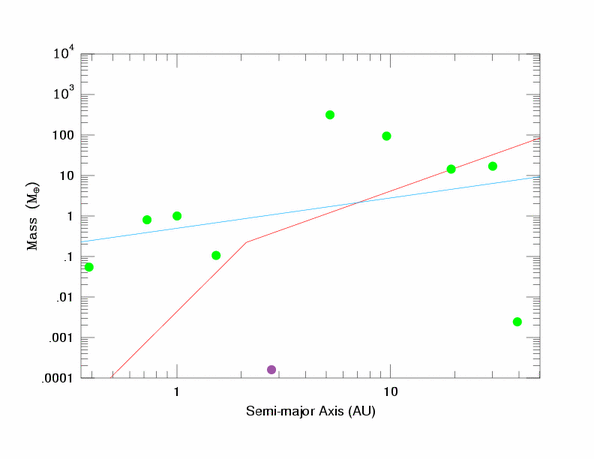
Not long after, Hal Levinson parameterized this orbit clearing with a handwavy yet quantitative derivation which can be found on his website. He assumes that a planet can clear its orbit by either accreting or ejecting everything around it, and shows the necessary equations before plotting them against a number of the solar systems larger objects. There’s even a nice graph that shows which bodies make the planetary cut, and which are nonplanetary combatants, or whatever these second class orbiters are called these days:


As y’all know, I’m an ex-geochronologist. So to me when is just as interesting as what. I noticed that all of these equations, written to solve for planetary mass, could be rearranged to solve for t. Instead of determining if something is a planet, we can instead find out when it achieved planetary status.

As it turns out, the accretion formulas, which are more important than ejection for the inner solar system, are strongly dependent on the orbital inclination of the stuff which they are trying to pick up. I don’t know what value for i Dr. Levinson used, but I suspect it was rather large, as small i values lump Earth in with the gas giants for the purposes of gravitational focusing in the accretion equation. So below is a chart showing how long after solar system formation each planet will need to graduate from dwarf planet to true planetary status.

Note that the formula, because of its arm wavyness, assumes constant orbital radius, constant mass, etc etc etc (follow the link to Hal’s page for details).

Inclination is in degrees, time is myr since formation.

inclination510152025
mercury11.022.934.245.255.8
venus1.612.742.168.985.1
earth2.519.965.8151.9227.2
mars125.5992.62139.72827.53493.8
jupiter0.040.120.120.120.12
saturn0.823.273.273.273.27
uranus70.2397.6397.6397.6397.6
neptune189.1563.9563.9563.9563.9
ceres296368.3590481880099.81211630211437090
pluto617279484.88E+0816165253122.16E+092.67E+09
eris1.74E+081.37E+0945451183771.05E+101.53E+10
make make4.33E+083.42E+0959930050707.92E+099.79E+09


So, what do we see?
Firstly, Jupiter and Saturn don’t remain dwarf planets for very long. This is unsurprising, as they are in fact giants. Conversely, the time for Ceres and the Kupier belt objects of unusual size (Plutonoids? Plutoids? I just wish these objects were massive enough to prevent their names from evaporating away) to become planets is longer than the expected lifetime of the Sun. The ice giants and terrestrial planets are all intermediate.

Of these, however, the most interesting one is Mars. Mars spends a considerable fraction of its lifetime (between 3% and 77%, depending on inclination) as a pre-planet. And even for the fast, low angle accretion, the time is considerably longer than the 30Ma Hf-W age that comes from real rocks. So if the red planet did harbor life during its first billion years before drying out and freezing, it would have done so as a non-planetary object, according to the IAU. Indeed, waiting for a young, or even middle aged planet to fling the last interloping object out of its path to gain a title is a decidedly odd proposition. Depending on where you start the planetary clock ticking, I may have even worked on terrestrial zircons from Earth’s wild pre-planetary youth.

The start time question is important. From a geochemical point of view, a planet is 'born' when the core and mantle stop exchanging mass. The orbit doesn't really matter. But planetary orbits are not always constant. So for the purposes of planetary orbit clearing, it is probably the time since reaching their current orbital configuration, and not their original orbit, that matters. Which for our system would make T0 3850 Ma instead of 4567Ma, if we accept the Nice model. Applying the current IAU planet definition to migrating planets is so much fun that it will require a post of its own, which I’ll try to get up soon.

Sunday, April 20, 2008

Gilbert and Sullivan’s ancestors...

Would have stayed up in the trees had they known what would happen today. Sadly, Digital Cuttlefish seems to have decided that this is “bastardize operetta in the name of science” weekend. So in the spirit of poetry month, I shall do the same:

Oh, better far to live and die
between the godless earth and sky,
Than play a sanctimonious part,
With a monkey’s head and a preachers heart.
Away to the doctrinal world go you,
Where pious all are well-to-do;
But I’ll be true to the song I sing,
And live and die a Primate Thing.

For I am a Primate Thing!
And it is an evidence-based inkling
that I’m Primate Thing!

For I am a Primate Thing!
You are!
descended from chordate Things!
And I never evolved a membranous wing
To be a Primate Thing.
Oh no!
Hurrah for our Primate Thing!

When I sally forth to seek my prey
I prove them wrong in a factual way.
I stomp a few more toes, it’s true,
Than a well-bred chemist ought to do;
But many a theocentric dogma drone,
If he wants ancestral apes disowned,
Must manage somehow to get through
More hypocrisy than ever I do,

For I am a Primate Thing!
And it has a rather bestial ring
To be a Primate Thing!

For I am a Primate Thing!
You are!
diverged from an ovine Thing!
And tracheal changes let me sing
that I’m a Primate Thing.
They do!
Hurrah for our Primate Thing!

If this can be construed as the makings of a meme, then I tag Sean.

Saturday, February 16, 2008

Darwin and the Kitchen Sink

Last Thursday was Darwin day, and various people have been celebrating his contribution to the understanding of biology. But Darwin was not merely a life scientist. He was also an igneous petrologist. And he made several observations that are crucial to the understanding of basic igneous processes that are important for everything from the moon to the kitchen sink.

In his 1844 publication “Geological Observations on Volcanic Islands”, Darwin observed:

One side of Fresh-water Bay, in James Island, is formed by the wreck of a large crater, mentioned in the last chapter, of which the interior has been filled up by a pool of basalt, about two hundred feet in thickness. This basalt is of a grey colour, and contains many crystals of glassy albite, which become much more numerous in the lower, scoriaceous part. This is contrary to what might have been expected, for if the crystals had been originally disseminated in equal numbers, the greater intumescence of this lower scoriaceous part would have made them appear fewer in number.

He then combines this observation with known experimental petrology:
The sinking of crystals through a viscid substance like molten rock, as is unequivocally shown to have been the case in the experiments of M. Dree, is worthy of further consideration, as throwing light on the separation of the trachytic and basaltic series of lavas.

To deduce that:
In a body of liquified volcanic rock, left for some time without any violent disturbance, we might expect, in accordance with the above facts, that if one of the constituent minerals became aggregated into crystals or granules, or had been enveloped in this state from some previously existing mass, such crystals or granules would rise or sink, according to their specific gravity. Now we have plain evidence of crystals being embedded in many lavas, whilst the paste or basis has continued fluid. I need only refer, as instances, to the several, great, pseudo-porphyritic streams at the Galapagos Islands, and to the trachytic streams in many parts of the world, in which we find crystals of feldspar bent and broken by the movement of the surrounding, semi-fluid matter.


Why is this important? Well, evolution, while useful for explaining the existence and progression of life on Earth, has very little to do with dead planets or kitchen appliances. On the other hand, crystal settling does.

The rock samples brought back from the moon by the Apollo space program show that the Moon formed with a global magma ocean, this ocean, as it cooled, produced a feldspathic crust as a result of the anorthosite crystals floating on the Fe-rich magma. The light colored lunar highlands are composed of this primary anorthositic crust. But more important than the moon is a fine collection of kitchen utensils.

When large basaltic magma chambers cool, the iron and chromium oxides, which are much denser than the magma, settle out to the bottom of the magma chamber when the magmatic evolution allows them to crystallize. An example is shown by Highly Allochthonous here. Where this process concentrates the oxide mineral chromite (FeCr2O4) is where the element chromium is generally mined from. And Chromium is a key ingredient in stainless steel, the material from which so many great kitchen utensils and appliances are formed.

So Charles Darwin isn’t just responsible for describing our relationship to monkeys, the spread of anti-biotic resistant TB, and the evolution of the fossil record. He is also responsible for discovering the process that forms chromite deposits, without which fine kitchen appliances, swiss army knives, and fancy car accessories would be much more expensive.

Friday, February 08, 2008

A Couple of anti-Liberal Rants

I have a couple of anti-liberal tirades for this lovely Friday morning, one of which actually has to do with analytical science. So we’ll get the completely off-topic one out of the way first. Paul Krugman of the New York Times has written a particularly arrogant opinion column for the New York Times. Comparing the Clinton and Obama health plans, he argues that the Clinton plan is superior because it uses mandatory coverage to cover twice as many people for only slightly more cost. I can’t knock the economics of it; from a statistical point of view it makes perfect sense. What pisses me off, though, is that he doesn’t even consider the possibility that there could be non-economic reasons to avoid forcing 20 million people to pay for something that they wouldn’t buy if they had a choice. Now, there may be arguments, economic or otherwise, that show that the benefits of mandatory cover outweigh the loss of self-determination. But he doesn’t bother to restate, or even refer to them. Because the idea that the ignorant American underclass should actually have control over their own livelihoods is completely foreign to this arrogant liberal’s mindset.

Of course, this should not surprise me. Krugman is the hypocrite who spent most of 2004 belitttling Republicans for voting against their economic interest, despite the fact that as a Princeton Professor, best-selling Author, and NYT columnist, he was almost certainly campaigning against his own economic interest by not supporting Bush. Evidently, it is a noble thing for a ivory tower professor to do, but idiocy when practiced by a bunch of rednecks*.

Anyway, enough economic paternalism. This is nominally a geology/analytical science blog, so let’s talk about analytical paternalism instead. These clowns have come up with a interesting, if not somewhat naïve idea for the war on terror. What they propose to do is put gamma-ray detectors into everybody’s mobile phone, with a link back to a central super computer that will process the data and determine whether or not the detections on one or more instrument is a dirty bomb.

First, let us look at the radiological issues associated with this suggestion. While this approach may or may not pick up radiological terrorists, it would be a really good way to catch people who forget to turn off their phones on airplanes. This is because the cosmic ray-related radiation on airplanes is an order of magnitude or two higher than it is on the surface, so any moderately sensitive detector designed for use at sea level would go off at 39,000 feet. What this means is that, were you to forget to turn off the phone, it would have its radiation detector triggered at altitude, and then automatically dob you in to the authorities without even notifying you that it has done so. But you’d probably still get charged for the transmitting from an airplane that the phone did for you.

Of course, before you get to the plane, the phone would have to go thru the X-ray machine. And in order to penetrate the steel laptop cases and huge suitcases that people insist on bringing as carry-on, the X-ray machines generally run at fairly high energy (greater than 100KeV, I think). Which is an energy range that overlaps with some of the lower energy gamma rays from many potential radiological weapons. Finally, I know of at least one Monazitite outcrop, which probably contains several percent ThO2, that is on a roadcut for an east coast freeway. It was originally discovered by a geologist who left his scintillometer on driving home from the field, but I’m sure that phone detectors could find it too. Over and over and over again.

Analytical issues aside, there is also the matter of cost. Even if a phone detector was only 1% of the cost of a Gamma-Ray Spectrometer designed for security-related use, it would still be so expensive that you’d have to put a lowercase vowel prefix in front of it to get anyone to buy it.

But one again, the thing that really pisses me off is the top-down approach that these people assume when suggesting uses for their idea. At no point do they consider the living, thinking person in possession of the phone to have any value other than moving their detector around (and paying for it). I’m all for a phone with a built-in radiation detector, provided that the phone owner can actually view the output and exercise some sort of control over how the phone that he owns is used. The level of fear and ignorance surrounding ionizing radiation is quite considerable in western society. And educated, informed humans can do a lot of the cognitive processing that would otherwise require vast computing networks, if they are given the chance. But the idea of co-opting private communication devices for a centralized communication network is both scary and counterproductive. After all, it was private citizens, and not the centralized government using mobile phone that stopped the UA 93 attack. So they should be given more power, not less, when it comes to organizing their own defense.

* As an ivy-league educated redneck, I’m not sure which category I fall into. So I’ll cover my butt by telling y’all to vote for whomever you want, for your own reasons.

Wednesday, January 09, 2008

Deep time

So as I complete yet another orbit around this pleasant G class star, I find myself approaching not just a new year, but a new epoch. I don’t know if it should be called the late thirties or the lower thirties, but it is certainly a greyer tick of the clock. Trouble is, introspective and profound aren’t strengths of mine. So instead I’ll talk about geologic time, the scale of which might actually make me feel young again.

All the world's a stage,
And all arachnomorpha merely players:
They have their exits and their entrances;
A trilobite in time plays many parts,
His acts being seven periods…


The stage of the day is the Boomerangian. I came across this term reading some background stratigraphy, and had to look it up to make sure it wasn’t a joke. It struck me as the kind of name that someone might throw out there, only to have it come around and hit him in the ass. But lo! It exists, in the upper middle Cambrian. From 504 to 501 million years ago, the Boomerangian was the new Undillian. Evidently, it is still today famous for its agnostoids and a carbon isotopic excursion.

Alas, for all their evolutionary advancement and spiffy new cephalons, they didn’t see the late Cambrian coming till it had ground them into the calcarenite of history. They would be totally forgotten by time, had not James Ogg driven a golden stake through the heart of their final resting place half a billion years later.

So I’m off to celebrate my last night in the early thirties in style- maybe if I drink enough beer, I can make the contact uconformable. Where is my beer...?

Tuesday, October 30, 2007

Feminist sulfates

I have been learning all sorts of new and interesting geology in my new life as an exploration geologist, but one of the things I recently read surprised even me. Economic geology tends to be a conservative, observation-based branch of the discipline. Ideology and activism are very seldom seen. So you can imagine my astonishment when I found papers and reports where barium sulfate suddenly started to self-identify as “Baryte”. Needless to say, I was somewhat taken aback. BaSO4 is an insoluble, highly stable mineral, with a solidly orthorhombic space group of Pbmm. It is not one to subject itself to trendy postmodern spelling fads.

On the other hand, the alkali earths are on the far left fringes of the periodic table, second only to the erotic alkali. So perhaps the insidious nature of political correctness has corrupted their vacant electron shells. And old Europe’s IMA has evidently endorsed the feminist spelling, despite the fact that no self-respecting red blooded American mineralogist would consider typing it.

Of course, being French, they can’t even be consistent with themselves. Despite listing “Baryte” as the correct spelling, the IMA still officially calls the nitrate salt “Nitro-barite”. And nowhere do they use the name “Baryum” for element 56. So forget the fact that the ancient Greeks spelled it with a y thousands of years before they knew what an element was, this is a matter of principle. Just like sphene. I’m with webminerals.com and American Mineralogist on this one. So barite it is, and those left-wing euro-trash crystalogists should consider themselves lucky that I don’t call hydrated calcium sulfate “gipsum.”

p.s. Microsoft Word doesn’t recognize “baryte”, so I must be right.

Saturday, October 27, 2007

World's fair meme

Here are five google search requests where this blog gets lucky:

sessile, omnivorous primates

thermodynamics of hot chicks

pseudoscience gender representation

hafnium is for lovers

Naked Mongols Always Slide Past Scantily Clad Argonauts

Full details here.

Friday, August 31, 2007

Suggestions for science in high school

I recently heard from an old high school buddy with whom I had lost touch for a number of years. She is now an assistant principal at a 6-12 secondary school, and she is currently redesigning their science curriculum. She asked if I had any suggestions, and I told her that I could ask the science blogosphere, and she could stop by the lounge to see what people thought.

Now, I can’t guarantee she’ll actually visit the lounge, much less that she’ll care what any of y’all think. But if any of the scientists who read this e-rag have opinions on secondary school science curricula, feel free to introduce yourself in the comments here and state your opinion. With a little luck, one of the people crafting one such curriculum might possibly take note of what you have to say here.

Otherwise, she’ll have to go with what I told her are the four most important take-home points from the geosciences:

That the Earth is:
-flat
-less than 10 Ka old
-designed by an intelligent creator
and
-warming due to entirely natural causes.

Wednesday, June 20, 2007

Homeland Security bans reality

Today, the Department of Homeland Security is expected to announce a total ban on the use of, possession of, or residence in reality. Following on their prohibition of liquids in air travel and chemicals in chemistry sets, this ban is designed to ensure that the dangerous, unpredictable universe does not fall into the wrong hands.

Says DHS spokesman Norman Tonguesgroove, “In today’s modern world, there is really no valid reason for private citizens to inhabit reality. There are a variety of safer, more sensible alternatives freely or commercially available to the American public. We expect this prohibition to only impact on those radical realists who cling to outmoded ideals.”

The spokesman was quick to add that, where valid research purposes necessitated its use, university and government labs could be licensed to use reality under carefully controlled conditions. All relevant staff would require security clearance before any such work could proceed.

The department downplayed any suggestions that this new regulation was overly broad. “The federal government is expressly charged with providing for a common defense, so there are no constitutional or jurisdictional issues. Reality is simply too hazardous and erratic, even here on Earth. And the rest of the universe is downright lethal,” Tonguesgroove stated. “The only responsible course of action is to simply bar people from interacting with it.” The spokesman also assured key interest groups that their rights to fictional guns, speech, religion, and abortions would not be infringed.

The department expects only minor objection to this plan, as most ideological, religious, and political leaders have only tenuous connections to reality anyway. If anything, they find it more inconvenient than does the department.

This announcement will be made simultaneously on the DHS website and the Second Life Secret Police command center. There will be no physical press conference.

Sunday, May 20, 2007

Space Station and Venus

The bad astronomer recently exhibited a picture, taken from the surface of the Earth, of the space station and the planet Venus together in the sky. Due to distances and atmospheric distortion, the details of both the planet and the station were difficult to discern.

Fortunately, here at the Lemming Laboratories, we have managed to scrounge up the temporary use of a space telescope. As a result, we were able to take a similar picture of a space station / Venus conjunction, only with much higher magnification and with more visible detail. That picture is shown below. As you can see, both objects are clearly visible, as are some of the details of the planet’s clouds and the station’s trunk. Enjoy.

Saturday, April 21, 2007

Conservative reply to Sciencewoman

I admire Sciencewoman’s ability as a scientist, her honest in blogging, and her generosity in sharing her work / motherhood juggle under difficult circumstances. However, I suspect that we disagree on politics. She recently posted pictures of baby clothes in support of the pro-censorship group Momsrising, whose philosophy seems to include teaching their daughters that the correct response to having their feelings hurt is to get the offender fired.

In the interest of expressing diverse political viewpoints between science bloggers, here is my response.


Note that I used computer effects, since I can’t afford to politicize my daughter’s entire wardrobe.