Tuesday, March 24, 2015
Monday, March 03, 2014
The first rule of microanalysis
Don’t run out of atoms.
Figure 1. The protagonist in this figure has insufficient iron atoms for his proposed procedure.
How many atoms do you have?
How many atoms could we possibly need?
Insufficient atoms available.
Posted by
C W Magee
at
1:31 AM
2
comments
Labels: Adequate explanations, After-hours analysis, Daily grind (or polish)
Wednesday, May 15, 2013
How many of your co-authors have you actually met?
In my meandering career from academia to government to private sector, and back into all the grey areas in between, I've been an author on a few journal articles, government reports, and other publications. Usually, these are collaborations between groups of separated people, not all of whom interact with every other member of the team. For example, in the academic literature, I have a total of 21 co-authors, of whom I have met 9. If we include government reports as well as papers, then I have 42 co-authors, of whom I have met 17. I find it interesting that this ratio is so similar between the two types of reporting (about 40%). So I was wondering: for those of you who read this blog and publish, is your ratio about the same?
Posted by
C W Magee
at
12:51 AM
5
comments
Labels: Daily grind (or polish), Moldering manuscripts, Scientific hoop-jumping
Saturday, July 16, 2011
Terminology Question
Is there a less clunky term for "post-Archean"? Obviously, post-Archean has been around since at least the PAAS definition from Nance & Taylor (1976), and it has obvious utility as "the time in Earth's history when the atmosphere contained oxygen", but I was wondering if there is an officially recognized word for it. Anyone?
Posted by
C W Magee
at
8:02 AM
2
comments
Labels: Daily grind (or polish)
Saturday, June 04, 2011
Born again zircons
Last summer, I spent a bit of time back at Geoscience Australia as a geochronologist for hire, helping out with some of their state and territory geochronology programs. The report from the study I SHRIMPed zircons for is now out, thanks to the awesomeness of the first author, Dr. Nat Koscitin.
In theory, zircons are forever. The oldest known Earth materials are zircons, and there are countless* papers describing how they accumulate overgrowths through numerous heating and melting events.
So I was intrigues when I saw the following embayments on one of the samples. It is obvious that the zircon structure has been altered somehow. Prior to analysis, I assumed that it would be metamict- zircon where the accumulated radiation damage has destroyed the mineral structure.
Embayed zircons (c) Geoscience Australia
Usually, metamictization allows the radiogenic lead to escape, leading to geologically meaningless uranium-lead ratios. So I was surprised when these inliers gave a beautiful age that was 25 million years (plus or minus five) younger than the igneous crystallization age.
Igneous ages (red) are distinctly older than embayment ages (blue), which are surprisingly (to me) tightly clustered (c) Geoscience Australia.
The inliers have very low, “metamorphic type” Th/U ratios, suggesting that the zircon was drastically recrystallized, if not completely destroyed and regrown. These zircons weren’t forever; they had their insides dissolved and reprecipitated when they were 25 million years old. I had a brief look through the literature, but didn’t find anything that looked particularly similar. So I flicked the interpretation back to the petrologists and/or fieldies in the text. They didn’t come to the rescue- at least not yet.
If anyone knows how these things form, what they mean, and where I can read about previous descriptions, I’d appreciate it. I hear that the Curtin University gang has seen something similar, but I don’t have a particular reference. Any tips out there?
* Well, hundreds at least
Posted by
C W Magee
at
1:19 AM
4
comments
Saturday, April 16, 2011
Dear Hypothesis
Dear Hypothesis,
It’s after midnight, and I’m sitting all alone in the lab, thinking of you. I recall fondly how in the rush of spring meetings, you first revealed yourself to me though the coy implications of supposedly unrelated talks. I remember the passionate nights that followed, chasing up all the relevant studies, and probing the mysterious gaps in the literature with the passion of youthful expectation and optimism. The revelation that we had the analytical setup necessary to cement our relationship thrilled me to no end, and I wasted no time devising a scientific protocol. While I knew it wouldn’t be easy, I threw myself into the challenges and groundwork. Those were the days, when your geoanalytical implications beckoned with wild abandon.
Even then, I realized that confirmation could be testing, and though I was naive to the ion optical prowess necessary to perform the analysis, I none-the-less soldiered on. We all fantasize about the beauty of supporting experimental data, and I was obviously setting myself up in this regard. While our dataset can be called many things, beautiful isn’t one of them. Mass spectrometry is hard, and the scars can be disfiguring. Never-the-less, it was a learning experience. And while it isn’t perfectly clear cut, it is clear enough to tell me that we’re through.
I know this hard. It isn’t what I wanted either. But at this point, there isn’t much choice. Even our fat, round error curves are not broad enough to cover the observed scatter. You could show me perfect spots of countrate-limited beauty from now until dawn, and our probability of fit would still be negligible in the morning. I might as well just shut down the instrument.
I won’t, of course. I have a reputation to maintain, and even if I know our relationship is doomed, we’re booked in here for the rest of the night. So I’ll keep going through the motions until morning. The boys would think less of me if I packed up now, and I don’t want to come across as a wimp. But really, it’s over.
Please don’t be one of those hypotheses who keeps hanging around after your time. I’ll admit that I haven’t come up with a new hypothesis yet. As long as I thought there was a chance for us, I was loyal. But even if you do hide in the error bars and keep calling from the shelter of hypothetical artifacts, I don’t fancy your chances. I’m on the lookout for someone new, and you’ll only beat yourself up watching us go. I do wish you all the best, of course. You’re a very attractive hypothesis, and I’m sure there are lots of theorists out there willing to overlook your lack of actual data. And while I hope you don’t rebound into the eye of a delusional crackpot, it’s a bit awkward for me to give advice at this point in time.
In fact, you have every right to be angry. We were in love, and I really thought it would work out. Had the data allowed, I was ready to give you my name make you my Theory. It just wasn’t to be. Despite all that, I do need to stress that I am faultless in this matter. Science is to blame.
sincerely,
your EX-perimentalist
Posted by
C W Magee
at
1:42 AM
15
comments
Labels: Daily grind (or polish), Pompous proclamations, Tricks for young players
Friday, July 30, 2010
Blogging here is continuous on geologic timescales
But those of you looking for subannual periodicity may be disappointed. I'm trying to finish a paper and progress has been slow. Do any of you parents or other obligatory multitaskers have useful strategies for keeping track of manuscript progress when available time is split up into 10-30 minute segments? I'm finding that by the time I figure out where I was up to the last time I was writing, the boy has thrown up on the carpet and the girl's run naked into the front yard, and writing time is over. I'm suffering from too much punctuation, and not enough equilibrium. Any tips?
p.s. The boy only sleeps 10 to 5:30, so getting up early only gives a small window.
Posted by
C W Magee
at
8:18 PM
4
comments
Labels: Daily grind (or polish)
Saturday, January 23, 2010
An open letter to the chemical rubber company
Dear CRC,
Ever since I was in high school, I have found your “Handbook of chemistry and physics” to be a useful reference tool for finding a variety of important physical and chemical constants quickly. Even in this internet age, having a dog-eared copy of the “Rubber Bible” in lab is useful when someone wants to know how to get unusual elements into solution, or remember which metals catch fire when put into water.
So it was with mixed feelings that I noticed your 2008 edition contained a one-page geologic timescale.
On the one hand, the inclusion of a geologic time scale is great. On the other hand, a book that is updated every year should endeavor to be current. And the time scale you included was from 1983.
The inclusion of radiometric numbers on a geologic time scale requires and accurate and precise method of determining geologic ages. And most of the methods used today were still in their infancy in 1983. The earthtime website shows just how much the timescale has been revised over the last century as methodology has improved. If you are going to include a timescale, please ensure that it is up-to-date: The International Commission of Stratigraphy updates the timescale regularly, and the Geological Society of America also has a recent timescale available.
Posted by
C W Magee
at
8:17 AM
2
comments
Friday, January 01, 2010
Happy New Year!
Happy New Year, everybody!
Let's be honest here folks. Last year was a bit hectic. Hopefully this year will not involve losing jobs faster than they can be found. I don't expect 2010 to be completely smooth sailing, but if we're lucky, some of last year's hard work just might start to pay off. Which would be nice.
A few months back, I visited a nature reserve where they recently upgraded the facilities. As with many upgrades, this improvement involved paving a perfectly happy forest so that access is improved for people trying to escape the urban jungle.
Pouring asphalt is generally detrimental to the ecosystem of the forest floor. But at least in this particular case a bracken fern was too stubborn to quit. May this be an omen to the rest of us.
Posted by
C W Magee
at
12:27 AM
1 comments
Thursday, August 13, 2009
Phase diagram question
What do you guys use to plot ternary phase diagrams?
Does it run on a PC?
Is it Excel-compatible?
Does it do 3-D (4 component) systems?
Does it correctly plot error ellipses?
If the answer to all those is yes, please let me know.
Posted by
C W Magee
at
9:34 PM
3
comments
Wednesday, November 05, 2008
Termination Shock
Definitions:
1. The outer part of the heliosphere, where the solar wind slows down to subsonic speeds due to interaction with the interstellar medium.
2. The surprise caused when the boss calls during an after-hours election-celebrating beer, to say that one's job is ending in a month.
I know I promised science, but I've been busy dusting off contacts and updating my resume tonight. Science will resume when I get the time.
Complaints, leads, or suggestions for oddball careers potentially off my radar are all welcome.
Posted by
C W Magee
at
9:52 PM
14
comments
Thursday, October 23, 2008
Liquid Nitrogen for Grownups
Everyone who has ever seen a mad scientist outreach knows that liquid nitrogen is fun. You can freeze people’s balls with it, shrink balloons, cast gasoline candles, and make great clouds of fog. It was even the molecule of the day last week. But there is a little known secret side to this substance. Believe it or not, it is actually a commonly used substance for real labs doing actual work. And while we may occasionally make ice cream with it, that isn’t why our labs buy it by the silo full. So below I’ll go through a couple of the actual scientific uses of LN2.
1. IR detectors. Infra red spectroscopy studies the wavelength of IR radiation given off or absorbed by various materials, depending on their composition, structure, or impurities. However, at room temperature, everything gives off a fair bit of IR radiation. So an IR detector in a microscope will detect the ‘glow’ of the surrounding instrument- as well as the detector components themselves- unless it is cooled down. Liquid nitrogen is the cheapest way to do this.
2. Gas separation. Water and carbon dioxide are two commonly studied fluid phases in geology. Studying them often involves separating them from air or other combustion gasses. Dry ice/ethanol slurries are cold enough to condense water, and liquid nitrogen condenses CO2. so you stick various parts of your gas line in buckets of those substances, and they freeze out for later analysis. These are called cold traps.
3. Gas purification. Sometimes, instead of condensing a gas for analysis, you simply want to remove it. For example, the excimer laser that I used to keep running used a gas mixture of fluorine, argon, and helium. Invariably, water would contaminate the gas reservoir, reacting with the fluorine to form HF and oxygen. The oxygen is no big deal, but the HF prevents the formation of excited dimmers that actually produce the laser light. Since HF is polar, it condenses much more easily than the other gasses, so we use liquid nitrogen to freeze it out. In that case, though, the gas is in a continuous flow, and you can’t let it get too cold or the argon might condense as well. For all you former students reading, this is why I get so pissed off when you guys let that cold trap run dry- if the coil warms up, then the entire 3 months worth of HF gets back into the gas stream and fucks up the electrodes when you activate the trigger.
4. Some solid state charged particle detectors, like the EDS system on the microprobe, also like to run at low temperatures. But I don’t know the exact reason for that.
5. Dry gas. Some of the liquid nitrogen in storage will inevitably boil off in storage as a result of imperfect insulation. This gas is moderately pure, but very dry, and thus is handy for things like venting vacuum systems, flushing furnaces, dusting shit off, and other random tasks that require low pressure, low oxygen, and/or dry gas.
How about y’all?
Posted by
C W Magee
at
9:15 PM
11
comments
Labels: Daily grind (or polish)
Thursday, September 25, 2008
Always use pencil
Write-in-the-rain notebooks are of dubious utility when used with water soluble ink...
Of course, waterproof ink in not necessarily a good defense. When I was a student, I once had a technician use my lab book to smother an ethanol fire. The fire went out, and the notebook even soaked up the residue, neatly removing the hazard. Trouble is, there aren’t many inks that aren’t soluble in ethanol. While the chromatography patterns were awesome, reconstructing my work for the past month was a bit of an effort. The nice thing about graphite is that it is insoluble in anything that doesn’t attack paper.
Posted by
C W Magee
at
9:06 PM
6
comments
Thursday, July 24, 2008
Stratigraphic column software
Does anybody out there know of any good, basic, easy to use software that will turn core logs into nice looking stratigraphic columns? It doesn’t have to be fancy, or have the ability to deal with structure- I just need something basic. And as always, cheap would be nice and free would be better. I just want something that will save me the wrist strain caused by drawing forty million little squares all the way down 3000 meters of carbonates.
Posted by
C W Magee
at
9:19 PM
13
comments
Friday, July 11, 2008
Mermaids in the outback
One of the great things about Australian English is the richness of unique and colorful expressions that are foreign to those of us who grew up speaking one of the Northern Hemisphere variants of the language. Some of these are common throughout Australia. indeed, there exist lists on the internet that will provide translations of various terms, albeit devoid of cultural context. And having lived here for 11 years, I’ve heard most of the slang that is in widespread usage. But there are some choice terms which, due to either the physical isolation of the outback or the cultural isolation of my former career in academia, I have not heard. This is one of my favorites:
Mermaid: A weigh bridge operator.
It may be that some of the readers of this blog are the sort of isolated, industry-deficient people who have no knowledge of logistics. As such, one or two of them may not have used a weigh bridge, or even know what they are. So for their elucidation, here is an explanation.
A weigh bridge is a set of very large scales, which are used to weigh freight trucks. This is done to determine compliance- or lack thereof- with any of the various rules in regulations that govern the trucking profession. In addition to checking weight, the weigh bridge also serves as an enforcement point for other rules, such as logbook inspection, etc.
Usage: The mermaids dinged me for being less than a quarter ton over on my rear axle.
Or
Sorry I’m two days late to site- I had to take the rig down the 4WD track to avoid the mermaids.
Most truckers seem to be drawn to the profession for reasons other than the bureaucratic quagmire that has been imposed on it by road safety. As a result, these rules and regulations are resented by many in the transport community, especially the small, independent operators who don’t have a head office to sort things out- or in some cases, the ability to read. This resentment towards the people who weigh their trucks explains where the term “mermaid” comes from.
Derivation: A cunt with scales.
Posted by
C W Magee
at
8:25 PM
3
comments
Labels: Daily grind (or polish), Outback Lemming
Thursday, July 03, 2008
Gas background suppression during ICPMS analysis
This is a brief technical note for any ICPMS users out there who are trying to analyse elements with carrier gas interferences. Although I am not in the private sector, I still interact socially with academic researchers from time to time, and a post doc recently approached me with a analytical problem that may be related.
In laser ICPMS analysis, it is commonly assumed that any background that exists in the carrier gas prior to sample acquisition will remain constant when the laser comes on and ablation introduces sample into the system. However, as a result of this recent query I dug up some 2 year old data where I investigated this effect, and I noticed that for gas interferences with high first ionization potentials, sample introduction can reduce the background. Thus if you subtract the unreduced background from the sample signal, you will oversubtract, and underestimate your abundance.
The following table shows a) the mean background counts for one Xe and two Hg isotopes (which are both contaminants in the Ar gas); b) The mean counts during signal acquisition, and c) the ratio of signal/background.
Note that when ablating the doped Na-Ca-Al-Si NIST 612 glass, the Xe signal is reduced to 93% of the background, while the Hg is reduced to 98%. Interestingly, this effect seems to be matrix-specific; ablation of rutile only reduced the Xe to 98% while leaving Hg unchanged.
I have no idea if this sort of thing has been published- its easier to mine the data then slog through a library which I can’t access. And since I’m not an academic, I don’t particularly care. But chances are this sort of effect is machine specific, so anyone trying to measure isotopes such as 130Te, 82Se, or 204Pb would be wise to check their own instruments before trying to quantify unknowns.
Posted by
C W Magee
at
5:44 PM
2
comments
Labels: After-hours analysis, Daily grind (or polish), Tricks for young players
Tuesday, June 17, 2008
Banished to the Never-Never
I’m about to head out bush again, with instructions not to come back until the drill bit pokes through into the new Olympic stadium.* This was supposed to happen 2 weeks ago, but a few inches of rain sent me slithering back to town until the ground dried out enough to get the rig in. So barring any more freak off-season storms, I should be out of touch for a good long while. I’ve programmed the cyberbrain to periodically update the lounge while I’m gone; please play nice with it. Cheers, y’all.
* It is a geographic fact that China is on the opposite side of the world to everywhere.
Posted by
C W Magee
at
5:26 PM
2
comments
Labels: Daily grind (or polish), Outback Lemming
Monday, March 03, 2008
Ninja miners and blood diamonds
Last night I went to a presentation on the ninja miners of Mongolia. Ninja miners are East Asia’s garimpeiros- illegal, non mechanized miners who dig up everything from gold to gravel as a livelihood. I knew a bit about how garimpeiros worked in Brazil from my time there as a PhD student, but I had no idea of the scale of the enterprise in Asia.
There is occasional western focus on the crime and environmental damage caused by illegal gold and diamond mining, the most infamous of which is the whole “blood diamond” kerfuffle of the late 90’s and early 21st century.
Blood diamonds, which according to De Beers are any diamonds mined by someone other than them, were of course all the rage in the waning years of the Clinton presidency. And they are what made me decide to get out of the diamond field. While I am not necessarily adverse to morally dubious geology, the thing that really struck me about the conflict diamond activists was that they were generally not interested in solving the conflicts; instead their goal was to make sure the diamonds they bought were clean, so that they could sleep at night without being reminded of the horrors of West and central African civil wars. Wear Canadian diamonds, and you can wash your hands of the atrocities. And what sickened me about the research community was the way that academics were happy to use this opportunity to fund their pet projects, but with a conflict diamond spin.
Of course, there is no scientific method on Earth that will distinguish between an Angolan diamond found in 2001 and one found in 2003. But the former is a conflict diamond, while the latter is a reconstruction diamond. And the reason for the difference has nothing at all to do with kimberlites, or defect structures, or resorption features. The conflict was solved with 15 bullets and some help from Mossad, after the CIA decided that Savimbi was a liability, not an asset. All the inclusion composition statistics in the world wouldn’t have had any effect on that decision. And yet, during the conflict diamonds debates, there were precious few vocal advocates of solving the conflicts instead of the diamonds.
Illegal gold mining has never gained the notoriety necessary to spark a Leonardo DiCaprio flick, but it is still notorious due to pollution issues. The basic methodology is this:
1. Concentrate heavy sands in a wooden pan.
2. Add a blob of mercury to the pan, and swirl, allowing the Hg to dissolve any gold that is present.
3. Pour the mercury onto the blade of a shovel.
4. Use a blowtorch to evaporate the mercury, and collect the gold residue.
If only mercury were an environmentally benign health supplement, this would be a fantastic method.
So, I’ve known about these sorts of issues for a while, but what I learned last night was that toiling in the shadows of the glamour diggers for gold and diamonds were huge numbers of Asians, like the ninja miners, who work in low value commodities such as sand, gravel, and coal. This sort of mining is especially prevalent in Bangladesh, India, and Indonesia. By some counts, there are more than 10 million people worldwide earning a living from the blades of their shovels.
Not surprisingly, there are some academics who study this phenomenon, and refer to ninja miners, garimpeiros, and other low tech resource workers by the evocative name of “Artisinal and small-scale miners”. They even have a web site. And while digging up rocks for a living is a hard and dangerous way to live, for many people it provides a cash stream that subsistence farming does not, which explains why the numbers are increasing.
Here in the developed world, the trend is in the opposite direction. As mining companies merge, operations are getting bigger, and staffs are getting smaller. Just last month, BHP announced that it will be designing its new mines to be worked entirely by remote control, with nobody on site and the mining operations and vehicles running either by computer control, or remotely from the air-conditioned suburbs of Perth. While the Pilbara doesn’t have a large native population, I wonder how this trend would affect workers in more populous areas. Is a person better or worse off risking their life in a mine, or sitting at home with a welfare check funded by robotic royalties? And more to the point, where will that decision be made, and by whom?
Posted by
C W Magee
at
5:38 PM
0
comments
Labels: Daily grind (or polish)
Wednesday, February 20, 2008
What I really want to know is...
the age of the youngest dolomite here on Earth.
It may not be the most profound or deepest yearning for knowledge, but it is what I want to know right now...
Posted by
Dr. Lemming
at
7:22 PM
3
comments
Labels: Daily grind (or polish)
Sunday, December 16, 2007
Trophy rocks
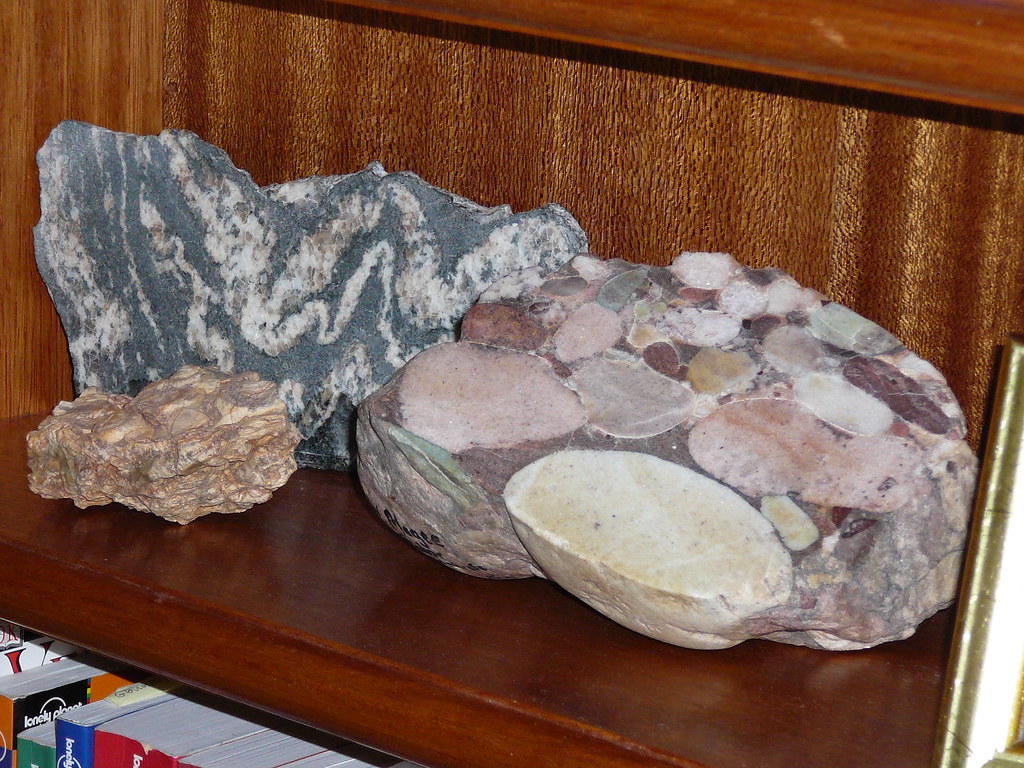
My first trophy rock is a 4 kg boulder of the Lavras conglomerate from the Tombador formation of the mid-Proterozoic Espinhaço Supergroup. This is a well-rounded, poorly sorted conglomerate with a clast size of 1-9 cm in this hand sample. The clasts are dominated by a pink arkose, with white and green arenites also present. The rock is clast- supported, and some clasts show evidence of minor pressure dissolution along their contacts. The matrix is slightly ferruginized. This rock is the purported source rock for the diamonds for the Lencois diamonds workings in Bahia state, Brazil.
My second trophy rock is a migmatite from the Wyoming craton. The strongly folded mesosome consists mostly of biotite and amphibole, with a minor opaque oxide phase. The leucosome follows the folds of the rock, but has equant, undeformed coarse-grained K-spar and quartz crystals, suggesting that crystallization was post-deformational.
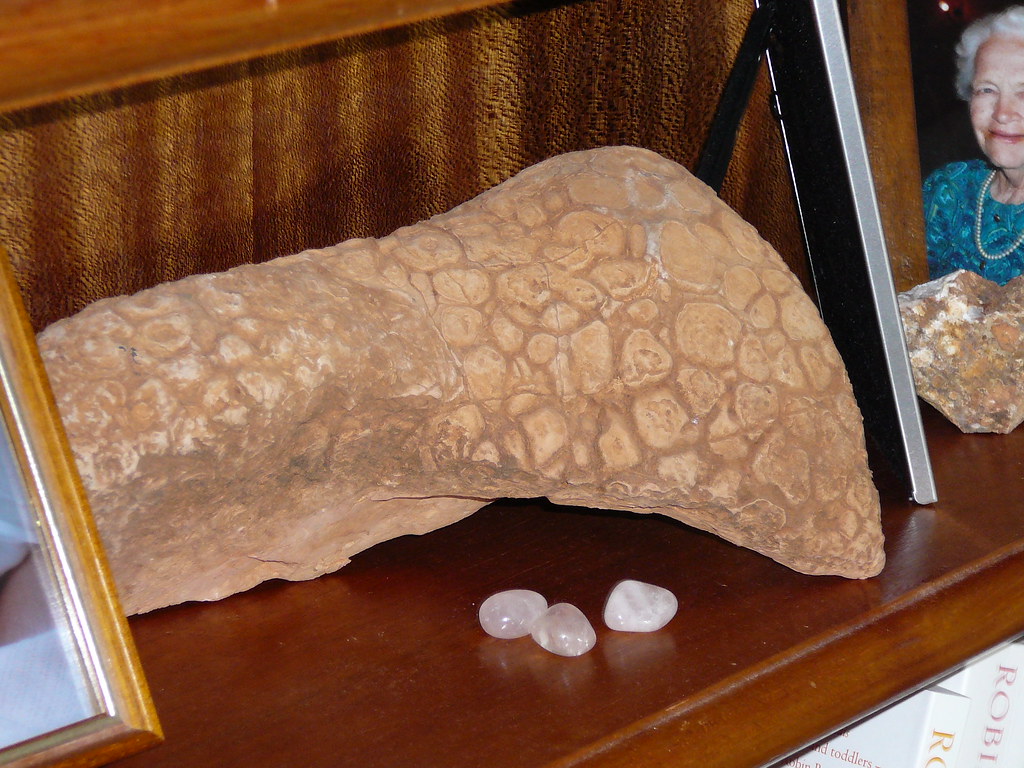
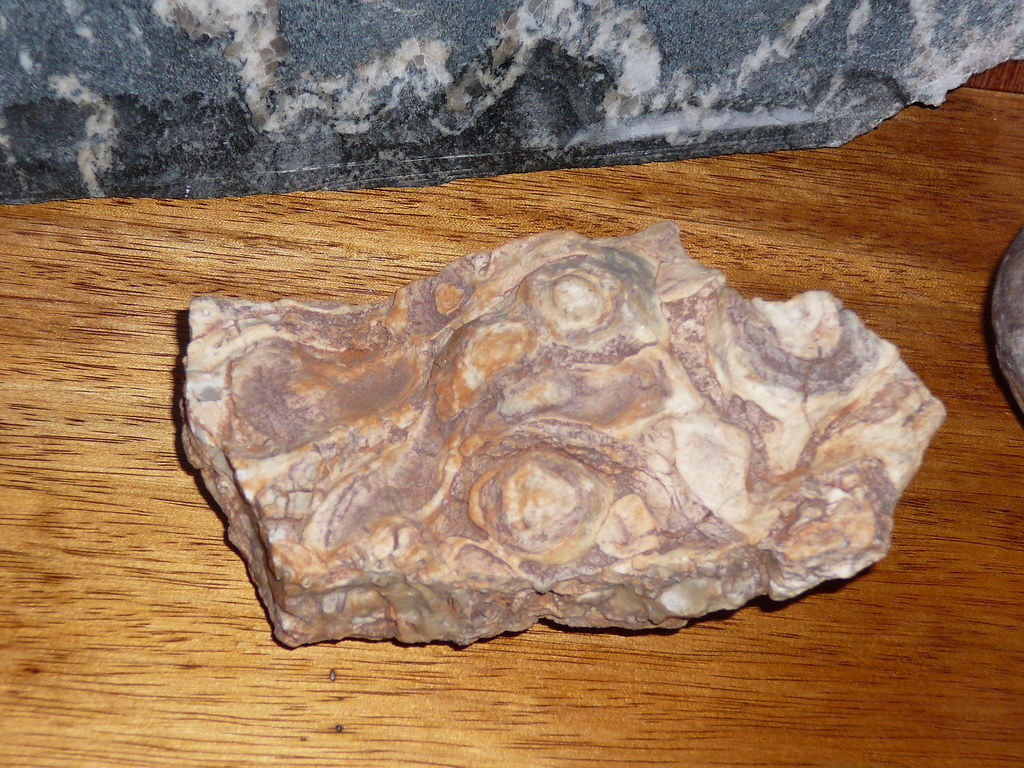
The third trophy rock, part A, is a 45cm Cambrian stromatolite colony from an undisclosed location in Australia’s Georgoina basin. Part B is a smaller fragment of a contemporaneous stromatolite colony, with which has been progressively silicified, showing laminar color variations caused by trace elements in the chalcedony.
Unlike Brian’s rocks, these specimens are widely separated in space and time.
Posted by
C W Magee
at
11:20 AM
6
comments