Showing posts with label Outta this world. Show all posts

Sunday, May 19, 2024

Dream big, young scientists

Looking back through old journals for something entirely different, I found the following research proposal that I wrote in Oct-Nov of 1996, shortly before I got awarded my PhD scholarship. It was a pretty good scholarship I got, so I'm repeating this in case anyone else wants to aim high in the planetary science field: 

Knowing the chemical and isotopic composition of the whole Earth would help constrain the mechanics, timing, and efficiency of differentiation and core formation, as well as give valuable information on the partitioning of siderophile elements into the core. Unfortunately, directly sampling the core is impossible using current technology. Many substitutes of this have been explored, including the analysis of the undifferentiated chondrites and the study of iron-nickel meteorites thought to be pieces of a demolished differentiated planetary body. 

Sadly, oxygen and other isotopes show that these objects formed in a region of the solar nebula different to the Earth, and thus their compositions cannot be directly compared to that of the Earth-Moon system without extrapolation. Since the Moon dies not include a substantial iron core, any determination of the whole Earth, or whole Earth-Moon system composition must include the Earth. 

Our proposal is to use Whole Earth Laser Ablation (WELA) ICP-MS to determine the chemical and isotopic composition of the entire planet. Building the mass spectrometer for this will be an easy task, as the Earth is already located in an extremely good vacuum. We are merely asking for enough funding to purchase a laser powerful enough to ablate the planet, so that the resulting plasma can be sampled by our mass spectrometer. We believe that based on its excellent performance in the Alderaan System, the purchase of a Death Star would allow us to use its primary weapon as our Earth-ablating instrument. We ask that you fund the acquisition of this tool, as we believe it will fundamentally alter the way we view our planet.

Thursday, February 18, 2021

Geosonnet 66

A Solo smuggler must hide his freight.
Hidden compartments store his shady wares.
So when a mineral conceals hydrate
There must be secret structure which ensnares
The water slipping through the MOHO line.
A fugitive from oceanic law.
How does an olivine the H confine
And store in crystal structure lattice flaw?
The brucite sidekicks are forsterite’s foils
Magnesium, low silica create
Tetragonal sites vacant, H embroils
This nominally dry mantle substrate
    Hot hydrogen won’t change the warring stars
    And yet it could distinguish us from Mars.

Geology 46 571

Other geosonnets: 1 2 3 4 5 6 7 8 9 10 11 12 13 14 15 16 17 18 19 20 21 22 23 24 25 26 27 28 29 30 31 32 33 34 35 36 37 38 39 40 41 42 43 44 45 46 47 48 49 50 51 52 53 54 55 56 57 58 59 60 61 62 63 64  65 66

Thursday, August 06, 2015

A one-way ticket to an unsuspecting Kepler 452b?

There has been a bit in the science press about the newly discovered exoplanet, Kepler 452b. This related to the observation that it is in the “habitable zone” of a sun-like star.  The big news, as always, is that this planet is completely unlike anything in our solar system. If it is solid, it has three times the mass than every rocky body in our solar system combined. If it is not solid, then it is one of the sub-neptune planets common everywhere but around our star.  But there are two points in particular which have been ignored- or at least not appreciated, which I would like to expound on.

Firstly, we can see them, but they can’t see us.  There are two main techniques used for detecting planets around stars: Radial velocity, and transits.  The motion of the planet around the star pulls the star backwards and forwards, in proportion to their relative masses.

With the radial velocity method measures the very small Doppler shift in the light of the star created by this pull. However, in order to see this motion, the orbit of the planet around the star needs to be somewhat edge-on as seen from earth. If we are looking town down on the orbit, then the star doesn’t move towards or away from us; it just goes in a circle (or ellipse). And sideways motion in the sky is much harder to detect that motion towards of away from Earth.

With transit detection, the crossing of the planet across the face of the star (as seen from Earth) causes the light from the start to dim a little bit in a periodic fashion. This requires Earthly observers to be in the same plane as the orbit of the planet- For a Earth-like planet orbiting a sun-like star, the planet will only transit if the Earth is within a half degree of the planet’s orbital plane.  The Kepler mission is a transit mission; all the planets it detects are systems which are edge-on as seen from Earth.

For aliens trying to detect us using the transit method, they need to be viewing us from a star that lies in the ecliptic. Basically, if they want to see the Earth pass in front of the sun, to detect its transit, then from our point of view, the sun needs to cross in front of their star.

However, the Kepler primary mission* field of view is nowhere near the ecliptic. It is, fore the most part, more than 60 degrees from the ecliptic. This makes transit detection of the Earth in front of the sun impossible from any star systems in the original Kepler field of view. And due to the high angle, radial velocity measurements of the Earth’s pull on the sun will be less than half as effective as our radial velocity measurements of their planets.

So the Kepler mission isn’t just a telescope.  It is a spy satellite, peering down on a thousand planets circling hundreds of distance star, all of whom are blissfully unaware of our planet’s existence.  If there are aliens on Kepler 452b- or any other planet Kepler discovers, they aren’t waving at us, because assuming technological parity, they can’t possibly know that we are here.

Of course, we know that they are there.  And it might be that one day,. given a modest technological advancement, someone could sent a colony ship on a hundred thousand year mission to visit them.  However, the visit could easily overstay its welcome.

Kepler 452b is probably not an Earthlike planet. However, if it does have an Earthlike composition, then it is a gigantic hunk of rock and metal three times more massive than every rocky-metal planet in our solar system combined. Due to gravitational self-compression, this planet would have a mass six times that of Earth.  At 36 hellagrams, it is just under half the mass of Uranus. The surface gravity would be a crushing 2.3 times greater than on Earth.  No rocket we currently have could even leave the launch pad under suck crashing gravity.  And even if it did, the velocity required to achieve orbital velocity, 15.5 km/s, is almost twice what is required on Earth.

Although technology is sure to advance if we are to get the ability to launch colony ships, such a huge planet would trap any rocket conceivable with current technology.  Kepler 452b is, in essence, a gigantic Hotel California, from which no-one can ever leave.  As a result, any short-lived visitation attempt would inevitably become a permanent stay.

So don’t be too disappointed if the locals on Kepler 452b don’t wave back.  They are blissfully unaware that we are staring at them.  And if they did know, the fact that we would wear out our welcome upon visiting by a factor of infinity is unlikely to cheer them up.

 * The secondary mission, however, is observing on the ecliptic.


Friday, May 01, 2015

Carnival of Space #403

Back in the days before Tumblr and facebook and twitter, people wrote blogs, read other blogs, and collate series of posts about common themes into link compilations called "Carnivals."  These days, most carnivals have dies out, due to the death of independent blogging, the loss of attention span to microsocial, and the increasing automation of trend formation.  But a few still live on, and one of them is the Carnival of Space.  Here is number 403.

Thursday, November 20, 2014

The wrong kind of Bang

In science education and popularization, there is a delicate balance that must be struck between overcomplicating and oversimplifying. Insufficient simplification can result in overly obtuse deviation into secondary details, which confuse and distract the readers and derail the flow of the prose.  Excess simplification can be wrong.  And this is where the Medium article by Ethan Siegel of “Starts with a Bang” fame has ended up. 

Dr. Siegel argues that the recent Philae comet lander would have more successful if it had been powered with a 238Pu RTG device instead of solar panels.  However, his simplified argument ignores the reality of 238Pu fuel production, the definition of “we”, and the nature of comets.

238Pu is a byproduct of the nuclear arms race between the USA and the USSR. It is created by neutron activation of 237Np, which in turn is a byproduct of 239Pu production for nuclear weapons. With the nuclear arms deals of the 1980’s the superpowers stopped building nuclear weapons by the tens of thousands, and the cheap source of 237Np disappeared.  The USA stopped 238Pu production in 1988, all subsequent material has come from Russia, which has almost depleted its stockpiles.

This brings us to the definition of “we”.  As the battleground over which the USA and the USSR fought, Europe never developed its own mass nuclear warhead production facilities; the UK and French arms supplies are only a tiny fraction of the size of the 20th century superpowers.  As a result, Europe has never had its own large scale 238Pu production facilities. 

Philae was a European mission, not a USA or Russian one, so the ESA (European Space Agency) did not have access to 238Pu needed for RTG production.  NASA (USA) and the ESA (Europe) are separate space exploration entities, a point that was very unclear from this article’s frequent discussion of NASA and Philae.

Finally, RTG’s are hot, and comets are cold. The Philae lander was a very risky mission- there was a significant chance that it would not succeed at all, and in the end the lander ended up bounding off an unexpectedly hard surface several times before ending up on its side in a crater.

Comets, by definition, evaporate at low temperatures- this one is jetting out gasses despite being way out beyond the asteroid belt. So landing a heat-producing source on it, especially on a lander that ended up tipping over, would end up in a situation where the lander could drastically alter the local environment of the comet through thermal contact.  The whole point of the mission is to sample a comet in as pristine condition as possible, so potentially cooking the comet due to a landing mishap is not really a sensible design choice.

Dr. Siegel is correct that 238Pu is crucial for missions that operate beyond the orbit of Jupiter.  But the fuel used on previous missions was subsidized by the nuclear arms race.  It, and all the wondrous outer solar system exploration it allows, was an unintended byproduct of Mutually Assured Destruction, and the tens of thousands of nuclear weapons that policy produced.  Since the arms race ended, production of this isotope for the sole purpose of planetary exploration has been deemed too expensive to pursue by all the world’s governments.  Until we collectively decide to blow ourselves up again, this barrier to outer solar system exploration will continue.


Wednesday, October 08, 2014

Total eclipse of the train

Tokyo is a busy city.  Thirty-six million people go call the region home, and go about their industrious, detailed lives with an energy and rigor unique on this planet. It is hard to know exactly what they are thinking; Japanese culture creates an aura or privacy and personal space that the geography tries to deny.  And for an outsider accustomed to wide open spaces, the locals here can sometimes seem hard to connect with.  But tonight was different.  While 8 o’clock is still the tail end of rush-hour in the hard working town, and Wednesday is hump day here as surely as it is everywhere else, this did not change the alignment of the sun and planets. 400,000 kilometers away, the full moon crossed the ecliptic, and the Earth, for an hour, blotted out the light of the sun on its airless surface.

And in that hour, the residents of Tokyo, and Melbourne, and Fiji, and Denver and Mt. Isa and countless other countries ‘round the Pacific stopped what they were doing, looked up at the sky, and watched the white light of the moon grow red and dim. The electricity and data kept flowing, the trains kept leaving, the advertisements kept flashing, the mechanical metabolism of the metropolis rumbled on unchecked, but for a brief moment, a short while, or a lazy hour, the inhabitants put aside the clockwork of their lives, looked up, and saw a distant world pass through our collective shadow.


Friday, August 29, 2014

Geosonnet 7

The Schrödinger bacteria’s Barsoom,
Where robots scan the wadi of the Styx.
There died, or never lived a microbe bloom
When déjà vu and Dejah Thoris mix,
Her hungry eyes fixed on Hadean seas,
Lowell’s  canal dream just an  aquifer.
The playa droid with X-ray vision sees;
Areocalcrete Earthings soon infer.
With carbonate and opal intergrown,
Australia’s prayer of cheap uranium,
As vengeful Ares, orbited by drone
Blends nukes and life within his cranium
  Thus Opportunity grinds sands of time
  Which mortals fancy Ceres made of lime.


Other geosonnets: 1 2 3 4 5 6 7 8 9 10 11 12 13 14 15 16 17 18 19 20 21 22 23 24 25 26 27 28 29 30 31 32 33 34 35 36 37 38 39 40 41 42 43 44 45 46 47 48 49 50 51 52 53 54 55 56 57 58 59 60 61 62 63

Tuesday, July 01, 2014

Don’t weaponize space

On the Planetary Society  website, the normally responsible and pro-science Planetary Society has posted an opinion piece by Louis Freedman and Tom Jones asking NASA to reconsider its refusal to fund the Asteroid Redirect Mission.  In short, this is a mission to kidnap a small asteroid from elsewhere in the inner solar system, and redirect it towards the earth, hopefully parking it in the most stable lunar orbit they can find (the Moon’s uneven gravity, and the tidal interactions between the Earth and Sun, tend to make most lunar orbits unstable).  Once there, the asteroid can do three things:
1. Fall into the Moon.
2. Fall into the Earth.
3. Be ejected into an Earth-crossing orbit around the sun.

One of the goals of this project is to give manned space missions a target that is easier to get to and from than either a wild inner solar system asteroid, or the Moon.  Because this will give them a stepping stone to Mars. 

The prospect of asteroid redirection technology being used to crash asteroids into the Earth doesn’t seem to faze Drs. Freedman and Jones; they don’t lay our any risk assessment or amelioration plans.    But an asteroid strike on Earth, especially a targeted asteroid strike, could be extremely damaging, as only nuclear weapons are capable of putting as much energy into the atmosphere in a comparable amount of time. And any asteroid-fetching spacecraft could be communicated with by a dish pretty much anywhere on Earth at some points during its flight. 


Amateurs often build radio receivers, point them at the sky, and listed to NASA spacecraft.  To date, nobody has managed to hack one, but there has been very little incentive to do so.  Putting a asteroid redirecting spacecraft into the inner solar system that is a computer hack away from becoming a weapon of mass destruction seems like a pretty rash thing to do, so I am surprised that the Planetary Society is advocating this.

Tuesday, December 10, 2013

Alien beyond comprehension

When an astronomer says a far-off planetary system is like ours, what he means is that it is completely different.  For example, see the recent press releases about the seven planet system KOI-135 (aka Kepler 90). 

This system has a planet the size of Jupiter in an orbit almost the same as our Earth’s.  Since the star is a little bigger (and hotter) than the sun, the orbit takes less time, but the orbital radius is just like ours.

Inside of that, in an orbit about the size of Venus’s orbit, is a Saturn sized gas giant planet.

Inboard of the Saturn-sized planet are three mini-Neptunes.  Our solar system doesn’t have any planets of this type, but they seem to be fairly common in the rest of the galaxy.  These are gas rich planets smaller than Neptune and Uranus, but still much larger than Earth. One of them has an orbit substantially larger than that of Mercury, one substantially smaller, and one about the same radius, but much more circular (Mercury has quite an elliptical orbit).

Finally, inside of that, are two earth-sized planets that orbit screamingly close to the planet.  The inner planet is more than five times closer to its star than Mercury is to the Sun, and its orbit (e.g. its year) is only a week long.  The other planet is only slightly farther out, in a 9 day orbit.

It is not known if there are more planets farther out- Kepler’s detection method would not pick them up.

So you gotta wonder, if that is Earthlike, then what are the strange ones like?

In fact, the whole framing of exoplanetary research as “counting up the Galaxy’s Earths” is a bit disingenuous.  By presenting a scientific study as having a foregone conclusion (e.g. there are Earths everywhere), NASA takes a lot of the suspense and excitement out of the search.  Furthermore, it makes trying to fit otherwise interesting discoveries into the Earthcount box awkward, and it diminishes the wonder and diversity of just what is out there.

In fact, the NASA exo-Earth search program is a lot like going to China to find a person just like your mother.  After all, China has billions of people, and they were all born more or less the same way as your mother, so odds are, the place must be crawling with women just like mom.

Imagine how tedious a travel documentary of China would be when viewed in this way. “Our way south to Beijing to look for mom-analogs was blocked by some kind of wall- fortunately we managed to avoid it).” You would have progress press releases, “Some people in China confirmed to be women.”  “New mission shows some Chinese women to be mothers.”  Newly discovered Chinese woman likes fried rice, just like your mom.”

This narcissistic approach misses the whole point of travel and exploration.  We investigate far-off places because they are foreign, because they expose the assumptions on which our beliefs are based, and because the let us discover new and wondrous things that were beyond the scope of our imaginations.


This is what exoplanetary research does.  Everything we have discovered in planetary science, from the first Moon probes to the discovery of planets 2500 light years away, has been wonderful and new and different to expectations and awe-inspiring.  But the current framing of the science does not allow this amazement to be conveyed to the public who fund the research.  And this is a terrible shame.

Thursday, December 05, 2013

The planets xkcd forgot

 A recent cartoon/poster on xkcd tries to estimate what the population of habitable zone planets in our stellar neighborhood looks like. Unfortunately, despite labeling the poster as “all habitable zone planets”, there are a couple of very important omissions.  The center of the picture should look like this:


When discussing the habitable zone, and how it applies to exoplanets, one needs to remember that the definition of habitable zone is sufficiently wide that it covers both Mars and Venus, the closest planets to Earth.  In fact, despite discovering thousands of exoplanets and exoplanet candidates, we still do not have any planets as earthlike as Venus. It is hard to say much about exo-Mars equivalents, as exoplanet detection technology has trouble finding a planet that small and far from its host star.

Most of the planets shown in the chart have not been discovered yet.  Even among those which have, very little data about the planets is available.  It will be years, perhaps even decades, before we have the technology to pick an exo-Earth from an exo-Venus. But framing the exo-planet debate as an Earth versus Venus relative distribution would be a mistake.  Chances are, the vast majority of these planets are completely unlike either planet.

Our solar system is strange.  It is missing the most abundant type of planet in our galaxy- those which are larger than Earth, but smaller than Uranus.  These worlds are often, albeit deceptively, referred to as “super-earths”.  But as Systemic has shown, those which we have data for are not only completely different to anything in our solar system, they are often quite different from each other. 


The omission of Venus and Mars is therefore important, because it gives the false impression that planets in the habitable zone are going to be Earthlike.  Neither of the habitable zone planets in our solar system are particularly Earthlike, and everything we know about exoplanets so far suggests that they will be far stranger still.

Friday, April 05, 2013

Why deflecting asteroids is a really bad idea

In the aftermath of the Chelyabinsk fireball last month, there have been increasing calls to identify asteroids on a collision course with Earth and develop technologies to deflect them.  This would be a very stupid thing to do.


The reason for this can be seen in figure 1, below.  In part A, this figure shows the minimum deflection necessary to make an asteroid on a collision course with  Earth to miss.  The deflection angle depends on how far from Earth this deflection occurs; the farther away, the smaller the angle.  In practice, very small angles from very far away would be used. 

The green line shows the minimum translational distance an asteroid must be deflected in order to miss the Earth.

Figure 1. An illustration for how the deflection needed to make an asteroid miss can be used to make many more hit.


The problem with such a system is shown in part B of the figure.  Here, an identical deflection is applied to a harmless asteroid that never would have hit Earth.  However, by deflecting it towards the Earth, this harmless rock ends up exploding in the atmosphere.  For a rock the size of the Chelyabinsk bolide, this is similar in force to a large nuclear weapon.

The area of the red circle- the smallest radius necessary to protect the earth- is three times the cross section of the earth.  So for every rock you deflect, there will be at least three harmless rocks that can be turned into weapons of mass destruction.  By definition, a “planetary defense system” turns every rock that passes close to the Earth into a potential weapon of mass destruction. 

Who would actually crash a space rock into a populated area of the Earth?  The same people who crash airplanes into skyscrapers of course.  And while only a few rouge countries can launch satellites, any spacecraft in radio contact with Earth can potentially be hijacked by a hacker on Earth with enough chicken wire to erect a makeshift dish in a desert.  Amateurs already pick up signals from our most distant space probes; an asteroid deflection mission would be a magnet for every doomsday cult, terrorist fanatic, delusional hacker, and other misanthropes whose imagination had previously been limited to shooting up schools.  Obviously nobody is going to design a space deflector to be hackable, but then the drone the Iranians hijacked wasn’t supposed to be vulnerable to those sorts of attacks either. 

The threat of an asteroid impact is miniscule.  More people were killed in floods this week than were killed by impacts in the known history of the human race.  A quick glance at the morphology of our planet will explain why.    Even the giant extinction-causing impacts are less common than large flood basalt eruptions of similar ecological lethality.  But developing the technology to deflect asteroids potentially gives all the wrong people access to a weapon the size of a large hydrogen bomb for a fraction of the development cost.  This is not a smart thing to do.

Tuesday, November 01, 2011

Thursday, September 29, 2011

Viewing imaginary spacecraft from the ground

I read and watched a lot of science fiction when I was young. I don’t much any more, mostly because I’m too busy, but every now and then I have a relapse. Also, for the most part, real science is more fun these days. But they aren’t necessarily mutually exclusive.

For example, this evening, I was thinking about the International Space Station. Under optimal viewing conditions, the ISS is the brightest thing in the sky, aside from the sun and moon. But while the station is surprisingly large (about the size of a football field), it is generally smaller than most science fiction spacecraft which are capable of interstellar travel.

Science fiction generally depicts people walking around on the ground, or starships floating close above a planet, but with little connection between the two; The only time I can recall people on the ground seeing spacecraft above are when the Death Star explodes in Return of the Jedi, and when the remains of the Enterprise re-enter the atmosphere in Star Trek 3. But if you can see the ISS from here on Earth, then surely a larger science fiction (or alien) spacecraft would be brighter still.

Figure 1. Since you can see the ISS from your backyard, you don’t need the force to detect something much bigger in the same orbit. Click for larger image.


Thanks to Jeff Russell’s Starship dimensions, scaled profiles of most major starships can be easily compared to the ISS. That’s all well and good, and we can estimate areas and visual magnitudes in the -7 to -10 range for various popular starships. But since there isn’t anything of that brightness in our skies, it doesn’t mean much, except to tell us that they would be easily visible from the back yard of anyone looking for them (assuming they aren’t in Earth’s shadow). But there is a useful celestial yardstick.

Figure 2. relative apparent sizes of various spacecraft (and the ISS) when directly overhead in a 350 km low Earth orbit, when compared to the apparent size of moon. The moon is of course 1000 times larger and 1000 times farther away. Click for larger image.


The Moon, which has a radius of about 1740 km, is about 1000 times farther away than low earth orbit. So a spacecraft 1000 times smaller- say, a flying saucer with a 1.7 km radius- would have the same apparent size when directly overhead. Thirty degrees above the horizon, it would appear half a big. In other words, the shape of kilometer-scale spacecraft, such as a Star Destroyer, or a Babylon 5 capital ship, would easily be discernable to people below. The 24 km-wide flying saucers from Independence Day would appear to be seven times larger than the moon, and would blot out the sun for up to 4 seconds as they passed in front of the sun.

So forget all the garbage you hear about radar jamming and government cover-ups. When the alien invasion fleet comes for us, we’ll be able to watch it from the back yard.

Figure 1 is from STS 118 and Return of the Jedi.

Tuesday, August 30, 2011

How odd is our solar system?

One of the most basic observations about the planets in our solar system is that there are two basic types. In the inner solar system, we have four rocky planets with radii less than 6500 km. In the outer solar system, there are four gaseous planets, with radii larger than 24,000 km. One long-held implication of this division is that there is some sort of significance in the lack of planets intermediate in diameter between Earth and Neptune.

One of the most striking observations from the list of planet candidates from the Kelper mission is just how unusual the terrestrial planetary size distribution is. The Kepler planetary radius distribution (figure 1) peaks in the middle of this gap; almost 70% of Kepler planet candidates are larger than Earth but smaller than Neptune.

Figure 1. probability distribution of Kepler planet candidate radii


So our solar system is unusual. But how unusual. A back of the envelope calculation will tell us. If we accept the Kepler figures, then only 30.8% of planets are, like ours, either smaller than 6500 km or larger than 24000 km. So the chances of an eight planet system having zero planets in this size range is 0.308^8. This works out as about one in twelve thousand. So for every 8 planet system like ours, there should be 11,999 with at least one intermediate-sized planet.

With a hundred billion stars in the galaxy, there are still bound to be quite a few solar systems like ours. But with only about 1800 known planets and planetary candidates discovered so far, it is unlikely that we will discover a solar system analog any time soon.


Wednesday, April 06, 2011

Radiation: reactor vs space


This plot, from exomaria, compares the relative radiation doses from various reactor accidents to that found on the surface of the Jovian moon Europa.

Anyone wondering why a mission to the Jupiter system needs radiation hardened electronics should look at this picture. For many scientists, Europa is the solar system's next best hope for hosting life. Fortunately for any would-be inhabitants, the icy crust of the moon should shield against all of this radiation.

For comparison, the daily dose on the International Space Station is similar to the Three Mile Island or Fukushima "3o km downwind" dose.

Thursday, February 10, 2011

Further consideration of the Kepler planets

A few days ago, I posted that a brief analysis of the size distribution of the Kepler planets suggests that the size distribution of planets in our solar system is unusual.

This hypothesis requires the lack of Earth-sized planets (compared to planets twice as large) to be real, and not a result of poorer detection efficiency for Earth-sized planets relative to slightly larger ones.

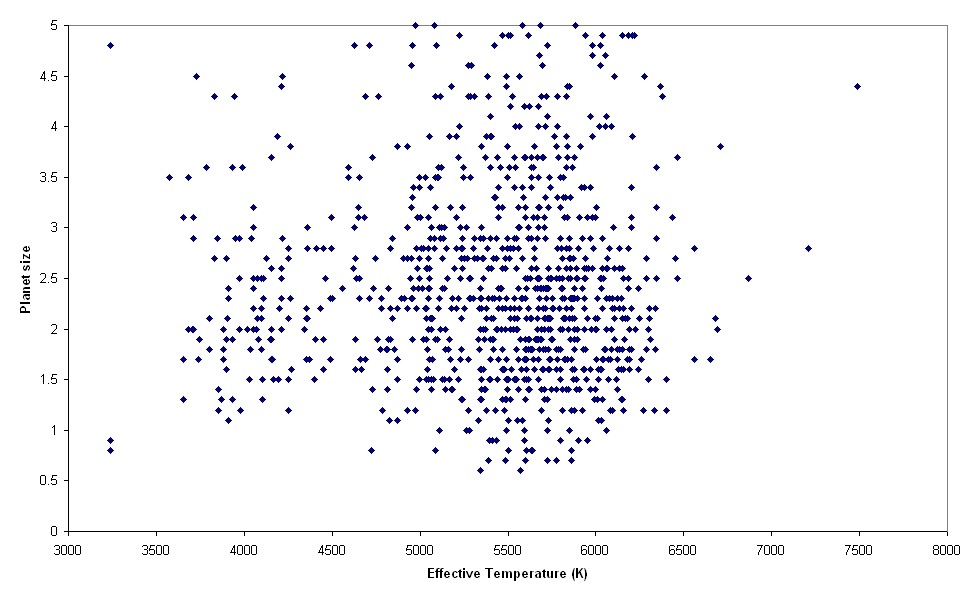
Commenter number one suggested that my figure two was not a convincing demonstration of this, and a comparison of planet size vs. spectral type (a proxy for effective temperature) or stellar radius would be more convincing. So here are those plots.


Figure 1. Planetary radius (relative to Earth) vs. effective temperature.


Figure 2. Planetary radius (relative to Earth) vs. stellar radius (relative to the Sun).


Figure 1 shows that earth-sized detections decrease for stars hotter than about 6000K, and figure 2 shows that they decrease for stars with a radius of more than 1.2 solar radii. This is not surprising, as the hotter stars will generally have larger radii, so a planet of a given size will block proportionally less light.

To correct for this, I have replotted a subset of the data release. Figure 3 is a probability distribution curve consists of only stars which have radii less than 1.1 times that of the Sun.


Figure 3. Probability distribution curve of planets around stars with stellar radii less than 1.1 times that of the sun.


Filtering out the large radii stars leaves a sample size of 953. The general shape of the curve is not too different than the whole sample. So the hypothesis that the most common size of a planet is midway between Earth and Neptune still seems to hold.

Tuesday, February 08, 2011

Our planets are weird

The Kepler data release has delivered a huge amount of data on planets orbiting stars in our galaxy.

This survey is designed to detect planets as small as earth (or a little bit smaller), and the way it works means that it most easily detects planets that are very close to their host stars. So most of the stars in this survey orbit their host star closer than Mercury orbits the sun. Despite this, figure 1 shows that there is something very unusual about our solar system.


Figure 1. Green lines are the radii of the planets in our solar system. Earth and Venus are blended together at this scale. The red line is the probability distribution of planets in the Kepler survey.


The most common planets in the Kepler survey have a radius of about twice that of the Earth, or about half that of Neptune. There are no such planets in our solar system. In fact, this gap is what we traditionally call the dividing line between ‘terrestrial’, or rocky planets, and giant planets (the giants are then further divided into the ice giants (Neptune and Uranus), and the gas giants (Jupiter and Saturn). There is nothing in between the ice giants and the rocky planets in this solar system. And yet, that is the most common size of planet in the Kepler survey.

There are a few caveats here. Firstly, is the peak is real or is an artifact related to the difficulty in finding earth-sized planets around dim stars? We can plot the magnitude of the star vs the size of the planet to determine this (figure 2).


Figure 2. Magnitude vs. planetary radii Higher magnitude stars are dimmer.


If the Kepler abundance peak around 12600 km (2 earth radii) in figure 1 is related to difficulty in finding smaller planets around dimmer stars, then we would expect the high magnitude stars to show fewer planets with a radius between 1 and 2 earth radii (the lower right portion of the graph). This area does not appear to be under-populated. So that caveat appears to be irrelevant to this study.

Another caveat is that the planets seen so far are all close to their host stars, and may represent migrated outer planets. So the distributions may be biased by a process that did not occur in our solar system. We can look at the period vs size distribution to test this (figure 3). If the earth-sized and smaller planets are all similar to the planets in our solar system, then they may have similar orbits. If the larger planets are all scattered in from the outer solar system, then they may have a different orbital distribution.


Figure 3. Kepler planets plotted by period vs. radius. Colored dots are Kepler planets, white stars are Mercury, Venus, and Earth. Period is in days, radius is in earth radii (6372 km).


What we see is that Kepler has not yet detected any earth-sized planets in periods as long as Mercury (much less Venus or Earth). That’s OK, such a detection is not expected for a few more years. All of the earth-diameter planets are in very short orbits. However, a few of the planets with a size intermediate between earth (1 earth radii) and Neptune (4 earth radii) have orbits that are broadly similar to that of Mercury or Venus. So these planets can not be definitively identified as scattered from their orbital period alone.

So, from the data we have so far, it appears that the galaxy is full of unfamiliar planets. Or, from the galaxy’s point of view, our solar system is devoid of normal planets, and only harbors oddballs.

Update:
See part 2 for further discussion of selection effects.

Monday, October 25, 2010

Meteorite tea, and the failures of genius

ResearchBlogging.orgIn the early 1970’s, Io, the innermost large moon of Jupiter, was somewhat of an enigma. Unlike Europa and Ganymede, it did not exhibit water ice adsorption bands it its IR spectra. Its density suggested that it was a rock and metal planet, but the surface reflectance was unlike anything known to science. This problem was addressed brilliantly in a Science paper by Fanale, Johnson, and Matson, researchers at the Jet Propulsion Laboratory. These scientists explained all the anomalous features of Io in a single stroke of genius.

By that time, it was known that meteorites were primitive condensates of the primordial solar nebula, even though the detailed work describing their subtle differences had not yet been completed. Since the outer moons of Jupiter were known to contain water, the study hypothesized that Io lost its primordial water and never accreted any ice later on. They then tested this hypothesis. Fanale et al. took a piece of the very primitive CI meteorite Orgueil, and made meteorite tea by boiling the piece of Orgueil in water. They then evaporated off the water and looked at the precipitate. What they found was mostly magnesium and sodium sulfate salts, with some halite and other elements mixed in. The reflectance spectra of these precipitates more closely matched that of Io than other hypothesized frosts, especially when treated with radiation. AS the evaporite was enriched in sodium, this process also efficiently transported sodium to the surface, where it can be ionized by ambient radiation, producing the Na ionization halo which was known around Io at the time.

So basically, the theory goes like this: during accretion, Io was too warm for ice to condense. Accretion from meteorites comprised of hydrous silicates released water as the planet grew and the interior increased in heat and pressure. This fluid then leached the rock, escaped to the surface, sublimed or evaporated, and left salts behind, which was what we see today. In other words, Io is an evaporite planet.

This theory explained everything know about Io so well that it would be another five years before Voyager one- at the time the most advanced robotic space probe ever launched- took pictures of Io as it flew past Jupiter which instantly and completely proved the evaporate hypothesis to be false.

The history of science is often taught as a series of breakthroughs generated by men of immense intellect who are smart enough to see the world as it is. But the reality is that the world doesn’t really care about genius. There are many incredibly brilliant scientific deductions- like the hypothesis of Fanale et al. of the evaporitic Io, which are spectacularly and brilliantly wrong. But science education has a powerful selection criteria that ignores all of the stunningly clever, but completely incorrect deductions. Instead, proponents of discarded theories are often depicted as dim, or close minded, or stuck in their ways. But in cases such as this one, they simply had no way of acquiring the data needed to disprove their hypothesis, as flying to Jupiter and looking at Io up close was science fiction in 1974. Five years later, it was history, and so was their wonderful model.

Fanale, F., Johnson, T., & Matson, D. (1974). Io: A Surface Evaporite Deposit? Science, 186 (4167), 922-925 DOI: 10.1126/science.186.4167.922

Sunday, September 05, 2010

Chlorine á gogo

There is a Universe Today article on the lack of organics found by the Voyager missions, which suggests that the chlorinated organics originally thought to be cleaning products could have actually been reaction products from Martian organics and Martian perchlorates (perchlorates and organic molecules react vigorously when given the chance- see the Space Shuttle’s solid rocket boosters for an example). The paper is not yet available, and I’m not a big fan of the press-release-before-publication model that NASA seems to be getting fond of these days. So I’m gonna sandbag the study based on the interview.

They say,

“One reason the chlorinated organics found by Viking were interpreted as contaminants from Earth was that the ratio of two isotopes of chlorine in them matched the three-to-one ratio for those isotopes on Earth. The ratio for them on Mars has not been clearly determined yet. If it is found to be much different than Earth's, that would support the 1970s interpretation.”


So, measure the martian Cl isotopic ratio and see in the Viking measurement is terrestrial or martian.

This is not a well designed experiment. We know from Sharp et al. (2007) that Cl isotope ratios don’t vary much either on Earth or in chondrites. One permil is 1 tenth of a percent, so a 1 permil difference is a change in 35Cl/37Cl ratio from 3.125 to 3.128. It is unlikely that the Voyager measurements are anywhere close to precise enough to see this sort of variation.

Long et al. (1993) show that surface processes on Earth change the ratio by up to 4 permil. Nakamura et al. (2009) show a similar change in Cl metabolized by organochlorine-eating bacteria. The only place Cl isotopic variations exceed 1% (ten permil) is the moon (Sharp et al. 2010), and this is due to an extremely hydrogen-poor environment (insufficient H for chlorine to volatilize as HCl when outgassing from magma) that we know doesn’t exist on Mars, as it is covered in ice and hydrous minerals.

Luckily, we have Martian meteorites. They have lots of Cl in them (Bridges et al. 2001), so we should be able to get Cl isotopic ratios for phases present in those samples. I suspect that Sharp might be doing that as we speak. But there is no reason to expect that the values will be different enough to terrestrial that they can be used to test the provenance of the Viking Cl isotopic analyses.

Saturday, September 04, 2010

Choice magazine to consumers: don’t eat white dwarfs

There is a Choice Magazine report advocating for stoplight rating of foods, to help consumers eat more healthily. Their rating system uses units of 100g/mL (see figure 1, below). That is tenths of a kilogram per milliliter. I don’t know what they are eating, but the densest known substance at the surface of the Earth is osmium metal, with a density of about 22 g/mL, or 0.22 100g/mL.

Their “green light” value for sodium is 0.3 100g/mL, which is about 50% denser than anything on Earth. For comparison, a pure halite crystal 1 centimeter on a side (salt conveniently grows in cubes) will contain 2.16 g/cc x 0.39 g(Na)/g(total) = 0.85 g sodium. In units of 100g/ml, pure salt thus has a value of 0.0085 100g/mL.

Never-the-less, they rate almost every cereal as having an orange or red light rating.

There can be only one explanation. While osmium may be the densest material at surface pressures, at higher pressures many things can be more dense. As an example, consider a white dwarf star. A white dwarf is the burned out core of a star which has run out of hydrogen fuel and collapsed into a super dense state. Although calculating a diameter (and thus density) is not easy, they are generally thought to be about a million g/cc, or a ton/cc. On the Choice Magazine scale, that would weigh in at ten thousand 100g/cc.

Of course, white dwarfs are mostly carbon and oxygen, not sodium. But lets assume that they have a solar O/Na ratio. Using the Asplund et al. (2006) values, the solar O/Na ratio is about 300. But since white dwarves have carbon, silicon, etc. in them as well, we should really look at the ratio of everything except H and He to sodium. This is about 600 (in other words, carbon plus nitrogen plus all the heavier metals are about as abundant as oxygen).

So a white dwarf sodium content, using choice magazine units, is about 16.7 100g/mL.


Figure 1. The traffic light rating table from the choice magazine report.


That is more than ten times the 1.5 100g/mL “red light” value they suggest.

So eating degenerate matter from the cores of burned out stars is not recommended by Choice. It contains too much sodium, and might give you high blood pressure.

M. Asplund , N. Grevesse, A. J. Sauval; The solar chemical composition; Nuclear Physics A 777 1–4 (2006)