Friday, January 18, 2013

I build huge cans of learning named after a small pink water animal with lots of legs.

I build huge cans of learning named after a small pink water animal with lots of legs. The can of learning fires the tiniest bits of air, hurried up by a field, at rocks to break them into the tiniest bits of matter. We suck all of the air out of the box, leaving only empty space. That way the bits of the rock don't hit bits of air that are in the way.

Another field sucks these bits off of the face of the rock, and into a big box filled with empty space and more fields.  The fields in the box sort the bits by exactly how heavy they are. The force that holds the bits together makes them a little bit lighter, so knowing exactly how heavy they are lets us tell tiny bits holding on to each other from single other tiny bits that are slightly lighter or heavier.
The very heavy bits are actually too big to hold themselves together. So they fall into pieces over time.  We look at how many pieces there are. This tells us the age of the rock.
People wonder how old rocks are.  My business builds cans of learning to tell them.
Brief: Explain your technical job using only the 1000 most common words #upgoerfive

Thanks to Anne and Chris for the brief.

Friday, December 21, 2012

The world has ended, but this blog rambles on.


In this timezone, it’s the 21st of December already, and the world has been destroyed.

Sorry guys, but the Mayans were right.  At 12:01 am, Eastern Australian Daylight time, this section of the world was destroyed.  The planet is disintegrating along the time-zone lines like the segments of an orange getting peeled off and tossed into a juicer.  Sorry folks, it’s all over.  And they didn’t even use my method for destroying the planet.

Fortunately, the super expensive Australian National Broadband Network is extensive and robust enough to survive this catastrophe, so I am still able to blog from the cosmic void.  It is getting cold and hard to breathe out here, but there are some benefits.  For example, without a globe there is no global warming.  And, in space, no-one can hear your neighbor throw up in the front lawn after a big night out.  And the big night will last forever.  Unfortunately, the nearest place to grab a drink is now the Saturnian moon Titan.  No word from the Mayans yet on when that baby is due to go.

Wednesday, December 12, 2012

Odd-shaped lakes in Google Earth

I was goofing around in Google Earth this evening, performing an activity that started out as meaningful and quickly degenerated into a Game of "Ooh what's that", when I came across the following:
Note the very strange shoreline on this lake, with numerous straight line borders. The first time I saw this, I thought I was looking at some dams I didn't know about, but I quickly realized that such an interpretation made no sense.

 Instead, what I believe this image is showing is a mosaic from pictures acquired several years apart. One of those years was a wet year, while another must have been after a period of extended drought. As a result, the lake is ~90% full in some of the images, but almost empty in others. And the straight-line lakeshores are just the tile borders, which Google's new color autocorrect makes less obvious.

 I have no idea where WoGE is up to these days, but I left the co-ordinates off in case anyone wants to chase up the Reservoir.

Sunday, November 18, 2012

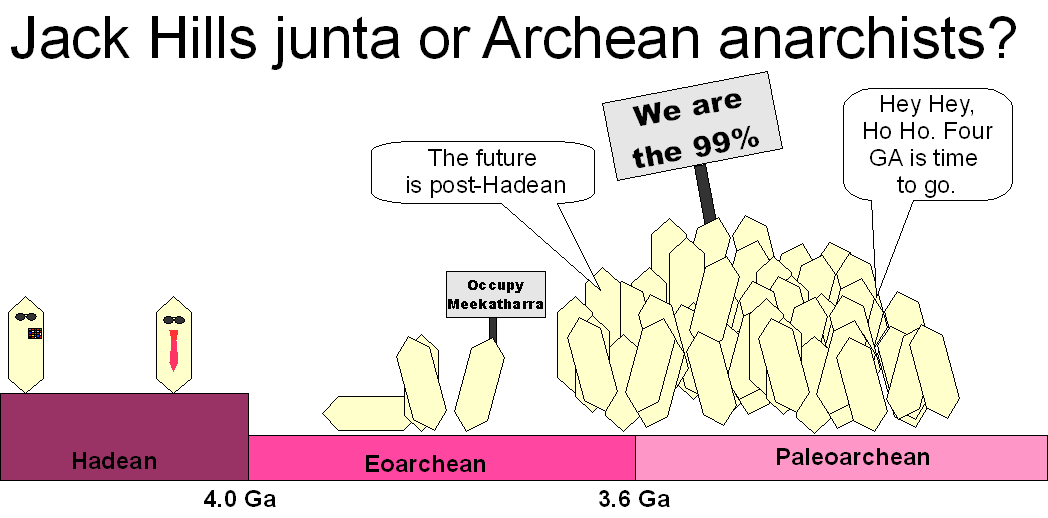
Pre-Proterozoic Political Proletariat

For those not familiar with old Earth geology, the conglomerates of the Jack Hills contain detrital zircons, and the 1% of those zircons which are older than 4 billion years consume 95% of the resources used to study these mineral grains. Clearly, this is the longest-running example of economic inequality on this planet.

Thursday, November 15, 2012

The trouble with climate models


For the past 20 years or so, people who have not wanted to consider the possible issues relating to increasing the atmospheric load of carbon dioxide and other IR-adsorbing gasses have tried to play down the dangers of potential climate change by pointing out that the computer models used to predict it were not very accurate.

The implication behind this argument is that the uncertainty in these models will overestimate potential changes. What will happen in a future where the models underestimate climate changes in generally unmentioned.

Luckily, we don't need to look to the future to investigate that possibility anymore. The above graph (from Neven's excellent Sea Ice Blog) shows the actual decline in summer arctic sea ice, relative to various computer model predictions. As this graph shows, ice is now melting much faster than any of the models had predicted.

Oops.

Of course, the most persistent pro-pollution propagandists tell us that this proves that the computer models are useless, which means that climate change can't be real, which means that any effects we see must be caused by the warming fairies instead of exhaust gasses.

Whatever.

What we, as scientists, would really like is this: We would like to be able to predict the effects of pollution on the climate before they happen. That's why we get into science. The whole purpose of the field is to make predictions about the natural world and then test them. So if y'all cook the Earth faster than we can make decent predictions about the warming, then we get very disappointed. Not as disappointed as all the retirees on the Jersey Shore who just lost their houses, but still not real happy. So folks, here is a request.

Could y'all please slow down the warming of the planet just enough so that we, the research community, can actually catch up and figure out who is happening to this atmosphere?We would much rather predict doom and gloom for the future than look at last week's disaster and shrug , "Yeah. We should have thought of that."

Wednesday, November 14, 2012


It has been a year since the solar panels on our house were installed. In that year, we consumed about 2750 kWh of electricity, and produced about 3370 kWh.

Thursday, November 01, 2012

If only politicians led by example

How great would it be if all the politicians running for office cancelled any new TV ad buys, and donated the money to hurricane relief instead?  With an estimated 6 billion dollar price tag for this year's elections, a the damages inflicted by Frankenstorm Sandy will still need additional funding, but it would certainly make a dent in the enormous damages that stretch across half the eastern seaboard and west through the Appalachians.  And putting that money into building new homes, fixing infrastructure and preparing the nation for the next superstorm would be a far better use than 2000 more hours of cheezy attack ads being beamed into space.  Sure, some of those ad buys have been paid for already- but visionary candidates, parties, and PACS can choose to run public service ads in that time.

Seriously, folks.  If takes just one candidate to tell all his supporters to fund the red cross instead of him, and suddenly his opponent is turned into the Grinch if he buys attack ads instead of charity appeals.  So which American leader is going to step up first?

Tuesday, October 16, 2012

Vote Geology in Ginninderra

Here in the Australian Capital Territory, there is a geologist on the Belconnen area ballot for next week's local elections.  Ms. Nash studied Geology at the ANU following her police and small business careers, and I had the luck to teach her intro geology when I was organizing practicals (labs) as a grad student in 1999-2000.  She was a great student, a successful businesswoman, and I'm sure she will make a great MLA.