Saturday, October 27, 2007

A380 take-off

Thanks to a weather delay, I was still at Sydney airport when the Singapore Airlines A380 took off for the return flight of the maiden commercial flight of the very big plane. It was fun to watch, but the really cool thing was the people watching.

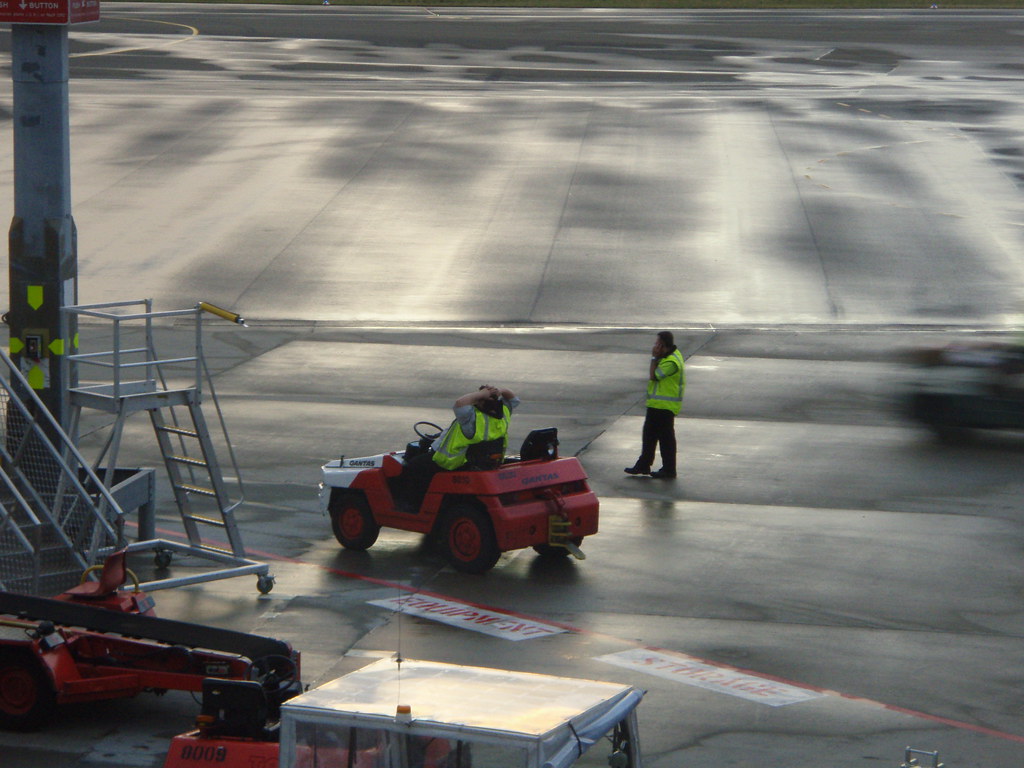
Pilots coming off shift called home, saying they'd be late for dinner because they wanted to see the plane. All the guys on the tarmac who were supposed to be driving trucks or loading luggage all stopped, and positioned themselves for an ideal view. As for the plane itself, it was definitely bigger than a 747 (A british Air flight took off immediately afterwards), but it only looked really huge next to a 737 or other narrow body plane. It left the runway remarkably early for a plane of its size, but the climb angle was incredibly shallow- it took a very, very long time for it to disappear into the cloud deck.


There isn't a lot of old-fashioned, 20th century style bigger, faster, stronger engineering going on anymore these days, so it was cool to see a bit of it in action, in the form of the biggest passenger plane to enter service in 38 years.

Australia is supposed to get the first commercial dreamliner flights as well, but I doubt they will look as formidable. That's a 21st century plane.

I have pictures, but no way to post them at present...
Thursday, October 25, 2007

Solar car race

Taking my fieldie to the airport this morning, we passed several cars racing in the World Solar Challenge. They were going slowly enough that they held up traffic- not surprising at 8:30 in the morning. Looking at the vehicles, we both thought the same thing- those cockpits must get HOT in the middle of the day. I doubt they have much in the way of air con. It turns out that the WSC has a blog. They might have pictures too- since I was behind the wheel, it wasn't practical for me to snap any.

Tuesday, October 16, 2007

Deadly Evapotranspiration

So, I seem to have missed the boat on this volume of the geologic carnival, as it has been published and lithified over at Shear Sensibility. But I’ll post anyway, as a philosophical exercise.

There are two endmember philosophies used to look at geologic processes, particularly those related to geomorphology. One is catastrophism, the idea that sudden, discontinuous, dramatic events are the driving force in shaping Earth history. The opposite is uniformitarianism. This school of thought suggests that the processes we can observe happening regularly today can explain all the geological events worth investigating. The dramatic nature of the current accretionary theme lends itself to catastrophism, so I will try to shift the balance by describing a process that is common, widespread, and deadly.

Evaporation, and its biological buddy, transpiration, are the basis for the hydrologic cycle. Without evaporation, we would have no rain, snow, rivers, glaciers, or humidity, and the earth would be a cold, dry, and barren place to live. But too much of anything can kill, and transpiration is no exception.


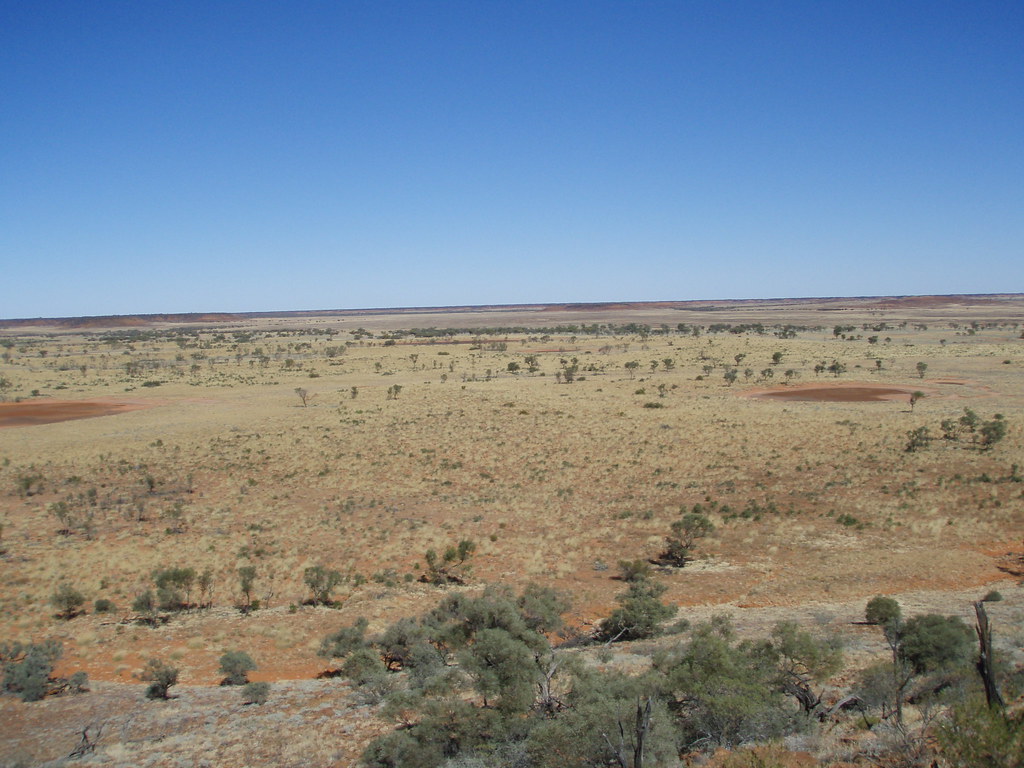
The playas shown above are an instance where persistent evaporation can become unhealthy. Here, on the northern edge of the Simpson Desert, evaporation reigns supreme, and there is little or no available surface water for most of the year. In such a climate, a person will transpire readily. However, without a source of water to rehydrate, this transpiration can rapidly turn fatal.

There are two ways transpiration can kill. The first is heat stroke. As the body loses water, it becomes more difficult to maintain a constant body temperature in hot conditions. If the body starts to overheat, and there is no available water for evaporative cooling, death can come quickly, as the brain starts to sustain permanent damage at temperatures much over 40 C.

Even if temperatures aren’t so hot, dehydration caused by transpiration can still cause death. Loss of fluids thickens the blood, and puts strain on a number of bodily organs, particularly the kidneys. Left untreated, it can cause organ failure and death.

I’m off for the final field campaign of the season (I hope). Working in the middle of a stable craton with very subtle relief, it is unlikely that volcanoes, earthquakes, mass wasting, or other catastrophic events will kill me. But every summer people in Australia are killed by the toasty end of the hydrologic cycle. I’ll try to make sure my crew doesn’t suffer that fate.

Later, y’all.

Sunday, October 14, 2007

Cetacean Liposuction

Last field campaign, I was discussing my whale farm proposal with one of our fieldies. As a South Australian farmer, he’s naturally interesting in any sort of animal husbandry that doesn’t require rain, so after a few kilometers he pointed out an obvious inefficiency in my scheme.

In the original plan, mankind’s oil needs were to be supplied by the slaughter of 630 million sperm whales each year. This isn’t necessarily a problem- environmental groups are historically indifferent to the plight of marine mammals, but it does create a waste management issue.

Whales are only about 10-20% oil, so the mass killing of millions of them would rapidly produce an inconvenient pile of whale carcasses. If the blubber could be extracted from the whale without harming the animal, then this inefficiency can be solved.

Thus, whale liposuction is the obvious solution. Without having to worry about the herd’s growth rate, a steady state population can be maintained with a factor of 10 fewer animals. This the size of the planet to house them will be similarly reduced. It would still require 10 times more water than exists in Earth’s hydrosphere, but instead of having to use Ganymede as a whale breeding facility, we could get by with an icy body the size of Pluto, or Triton.

And there might be additional bonuses. The planet’s cadre of cosmetic veterinarians need never worry about unemployment again, and the prospect of seeing svelte, physically fit whales might broaden the pool of prospective whale watchers.

Saturday, October 13, 2007

Climatologists- in it for the money?

One of the recurring themes in anti-global warming arguments is that earth scientists are hyping global warming so that they can get rich off of the increased research funding. The recent Nobel Prize results will probably initiate yet another round of motive questioning. Unlike some of the wishy-washier arguments made against climate change, this one is testable.

Suppose a college graduate in geology is looking to earn some money. Is climatology his best bet? For recent graduates, the next step towards a climatology career is a PhD. So, how do climatology PhD scholarships compare with other career options available to graduate geologists?

Well, PhD scholarships can be quite variable. This one gives A$19930 per year for three years. I found several other Australian universities that offer scholarships between $19,500 and $20,000 per year

Things in Europe are a bit more lucrative- this mob is offering 38,000 euros per year- more than twice as much.

I haven’t seen any American stipend figures in my brief net search, but my impression is that they are generally even lower than the Australian examples.

So, what other options does a freshly minted geologist have?

With a bachelor’s degree, a college grad is qualified for a junior position in the resource industry. But are these positions comparable with a PhD scholarship? After all, that European stipend looks pretty cushy. Here are a few entry level jobs advertised on seek.com.au, a popular Australian job site:

Coal mining: $100,000 - $160,000 (experience preferred, but graduates encouraged to apply)

Nickel- $85-$115K

Unknown type- $95-$125K (this actually asks for 1 year experience, so is not strictly a graduate level job)

Iron ore $80-$110K

Admittedly, most junior positions listed don’t name a figure, and people in the know say that $60,000-$75,000 is a more realistic expectation for a graduate with no work experience or advanced qualification. So there seems to be a selection bias in the ads that list potential salary figures. However, I expect that the same may be true of PhD programs.

So, if we assume a conservative Australian industry starting salary of $60,000, and compare that with an Australian PhD scholarship of $20,000, then it appears that those money grubbing climatologists are earning about a third of what they could get working in the resource industry.

Of course, climatologists won’t be students forever. In five years, they could be post-docs, earning about $50,000. In a comparable period of time, a senior geologist should be looking at about $150,000, still three times the academic salary.

Thus, the hypothesis that climatologists are in it for the money does not stand up to quantitative analysis. At least at the moment, an industrial career is several times more lucrative than an academic one.

Friday, October 12, 2007

Parenting is not babysitting


Last break, I was sitting in a coffee shop, rocking LLLL’s stroller and sipping at a flat white. A woman with a not-quite-toddler came up to me and asked, “So, baby sitting today?”

No.

Babysitting is looking after somebody else’s child. Looking after one’s own child is called parenting. Or in my case, fathering. The number of people who refer to a dad looking after a baby as babysitting is actually a bit surprising. And annoying.

Babysitters get free pizza, pocket money, and access to movies that their folks don’t let them watch at home. It is a commercial transaction. Parents don’t get paid- we do it all for love. A dad doing his parental duty should not be such a rare sight that people assume he’s getting some transactional reward out of it. It’s just something we do.

If someone asks me again, I might just say I’m a kidnapper. They’d probably be less surprised.

p.s. Littlest Loveliest Lab Lemming is half a year old!

Corkwood flower


We may be working 15 hour days in brutal conditions, but that doesn't necessarily mean that industrial geologists don't occasionally find the time to take a breath and sniff the roses hakeas.

Monday, October 08, 2007

Too hot for science

I have a new definition for when it is too hot for fieldwork. Last week, the rig broke down, so the other geo and I had a free afternoon. We decided to do some recon in an area of cambrian arkose. The sandstone was somewhat ferruginized, the day was hot, the sky was clear, and there was no wind. About midafternoon, I tried to pick up a rock to get a better look at some stratigraphic features. I failed. I failed because the rock burned my hand. So, my new definition is this: It is too hot to do fieldwork when you can no longer handle the rocks with bare hands.